
Love, Faith and Purpose
If the sense of a separate self loosens, what gives care for others its direction?
Revised Edition (2026) · Catalogue reference 3.4.9
Watch the chapter video
Why Awakening Leads to Compassion | Modern Alchemy
The chapter in brief
Following The End of Saṃsāra, the ninth chapter of Subject asks what directs action as the urgency of seeking fades. Robinson opens with reverence for what he calls suchness. In his alchemical account, Citrinitas brings enough clarity to discern habitual reactions, while the more complete dissolution he associates with Rubedo lies beyond this stage. He pictures that discernment as distilling gold from sediment, bringing Yogācāra’s storehouse consciousness into conversation with the Mahāyāna idea of the Truth Body.
He then considers how adversity is received and how help is offered. He reads the seventh bodhisattva ground through skilful means and sees goodwill as sunlight that falls wherever it reaches. Love, faith and purpose name qualities he expects to mature together as the distinction between personal gain and another being’s welfare loses its force.
How might insight change what moves us to act?
The hosts open with purpose and a mirror that reflects a golden figure into the distance. They take the receding images as layers of habit and identity. The mirror becomes a cluttered attic, lit by the solar clarity that the book associates with Citrinitas. The hosts then borrow the two birds from the Muṇḍaka Upaniṣad, one eating the fruit and the other watching, to distinguish being caught up in a reaction from noticing it. Their identification of the watcher with the Truth Body is a comparative reading. The image makes room for a question about motivation. If a person feels less compelled to prove their worth, what still gives action direction?
The discussion tests its answer with a hypothetical dismissal. One host voices the objection that calling a loss someone’s “rightful dues” sounds like victim-blaming. The other presents the chapter’s account of karma as a balancing ledger and argues that this reframing can change how the loss is carried. The analogy can illustrate a chosen response to adversity. It gives no grounds for assigning a hidden cause to the loss or excusing the employer’s conduct. A pocket watch then pictures dependent origination. Looking behind the face changes the hosts’ account of how behaviour comes about. Their further claim that acts follow with mathematical inevitability goes beyond what the analogy establishes.
The hosts compare compassion to one hand helping the other and then reach for an emergency rescue to explain upāya, or skilful means. Both images convey immediate responsiveness. The rescue example concerns an imminent danger, and its urgency supplies no general licence for coercion. The conversation moves on to “sleeping Buddhas”, sunlight that falls without preference and an image of faith as a bird sensing dawn. Together these images ask what becomes of care when a person’s present behaviour no longer exhausts how we see them. The recording’s stronger claims about guaranteed compassion and its neural basis remain unsupported.
Near the close the hosts work through Table 58, linking generosity, ethics, patience, effort, meditation and wisdom with skilful action. That sequence is their reading of a particular bodhisattva map. The apple tree with which they sum it up suggests that purpose can grow from favourable conditions. A practical question remains after the recap: how can care become less transactional while staying answerable to the person it is meant to help?
How the argument unfolds
Purpose opens the inquiry
The figure in the mirror gives the hosts an image of earlier habits and identities that continue to shape the present.
Clarity changes the relation to habit
The solar-lit attic and the two birds lead from distillation to the question of how action might arise from fullness.
Job loss tests the debt metaphor
A hypothetical dismissal brings the objection of victim-blaming into the hosts’ discussion of karmic dues.
The watch is opened
The gears illustrate conditioned behaviour and prepare the move from dependent origination to compassion and skilful means.
Goodwill takes a solar form
The sleeping Buddhas, sunlight and a bird sensing dawn connect goodwill with faith in others’ capacity to change.
The closing sequence returns to conduct
The seven perfections and the fruiting tree present care as something that can mature through ethical and contemplative conditions.
Book and recording
The chapter begins with reverence
Suchness and the first impulse of devotion open the book’s inquiry before distillation, karmic dues and skilful means come into view.
The recording begins with motivation
The mirror, the dismissal and the watch turn the chapter’s claims into examples about identity, adversity and action. The hosts leave their account of the seven perfections until late in the discussion.
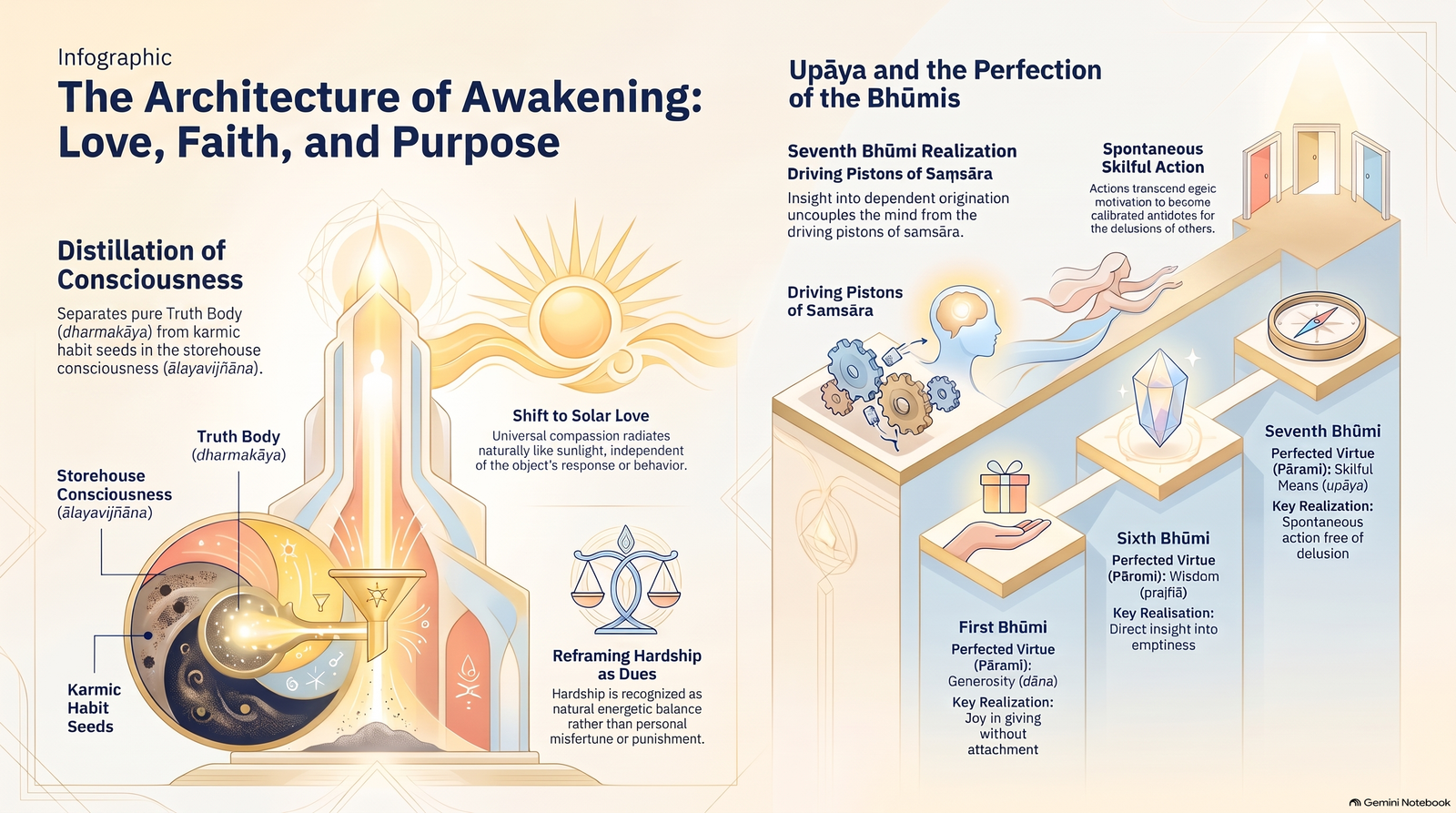
Read the diagram in words
The left side pictures habits as seeds in a storehouse and awareness as gold emerging through distillation. The sun represents goodwill that does not depend on a reward. Scales represent the author’s “dues” metaphor. On the right, gears depict recurring patterns of suffering, and the stairs pair the first ground with generosity, the sixth with wisdom and the seventh with skilful means. The distillation and energetic balance are metaphors. In The Ten Bhūmis, the first ground already corresponds to the path of insight, and the sixth places special emphasis on wisdom. The seventh is called Gone Far, and skilful means is its associated perfection.
Video chapters
These are the markers published on YouTube. They are approximate listening cues, and some labels differ from the order or emphasis of the spoken discussion.
- 00:00Opening: Love Beyond Emotion
- 02:40The First Impulse After Awakening
- 06:50Suchness and the End of Separation
- 11:30Citrinitas and the Solar View
- 16:20The Ālayavijñāna Explained
- 21:10Karma as “Rightful Dues”
- 26:40The Architecture of Purpose
- 31:20The Seventh Bhūmi and Skilful Means
- 36:30Sleeping Buddhas and Universal Compassion
- 40:10Love, Faith, and the Luminous World
Glossary
Suchness (tathatā)
Often translated as “suchness” or “thusness”, this Buddhist term points to the way things are, as understood within a given teaching. Mahāyāna accounts use it in relation to reality as realised by wisdom. In the chapter, it expresses the sense that experience can be met without the familiar pressure to defend a fixed point of view.
Ālayavijñāna
In Yogācāra, “storehouse consciousness” names a conditioned continuity through which tendencies or “seeds” from actions and experience can shape later experience. The recording’s attic and hard drive are images for this continuity. Its suggestion that the storehouse contains a pure essence belongs to the chapter’s alchemical account.
Dharmakāya
“Dharma body” or “Truth Body” is a Mahāyāna term for a dimension of buddhahood. Different accounts relate it to reality, wisdom or awakened qualities. The image of gold separated from sediment is Robinson’s way of bringing this idea into conversation with conditioned habit.
Karma (Pāli kamma)
In the early Buddhist Nibbedhika Sutta, intention is central to karma expressed through body, speech and mind. Buddhist traditions also discuss how the results of action mature. The recording’s balancing ledger is a particular interpretation. Pain by itself provides no basis for inferring what someone did to bring it about.
Dependent origination (pratītyasamutpāda)
This Buddhist teaching concerns the arising and ceasing of phenomena in dependence on conditions, with early formulations often tracing how suffering arises and how it can cease. The pocket watch illustrates interdependence in the recording. Treating people as mechanisms with a single inevitable outcome goes beyond what that image can show.
Saṃsāra
In Buddhist usage, saṃsāra is the round of conditioned rebirth and suffering. The hosts also give it a psychological sense through the cycle of striving, brief satisfaction and renewed dissatisfaction. The promotion example illustrates that everyday cycle, while the traditional term has a wider scope.
Bodhisattva and bhūmi
In Mahāyāna a bodhisattva aspires to buddhahood for the benefit of beings. A bhūmi is a ground or stage in accounts of that path. In the ten-ground scheme used here the seventh is Dūraṅgamā, translated by 84000 as “Gone Far”. It gives particular emphasis to skilful means.
Pāramitā (perfection)
A quality developed on the bodhisattva path, such as generosity, ethical conduct or wisdom. Mahāyāna sources give different lists, often six or ten. The recording uses the seven entries in the chapter’s table. Pāramitā is the Sanskrit term used here, and pāramī is the Pāli form used in the book.
Upāya (skilful means)
In Mahāyāna, upāya includes adapting a teaching or response to the needs and capacities of those it is meant to benefit. Robinson links this with spontaneous compassion. Whether a particular response helps remains an ethical question involving the circumstances, the person’s wishes and the consequences.
Mettā and compassion
Mettā is Pāli for goodwill or loving-kindness, the wish that beings be well. Karuṇā is compassion directed towards suffering. The recording brings them together through “solar love”. The sunlight image is Robinson’s, while the early Buddhist Karaṇīya Mettā Sutta describes the cultivation of boundless goodwill.
Buddha-nature and “sleeping Buddhas”
Buddha-nature teachings in Mahāyāna offer differing accounts of the relation between beings and buddhahood. The hosts’ language of “sleeping Buddhas” gives that idea an ethical use. It invites a view of people wider than their present behaviour, while leaving their conduct and its effects open to judgement.
Related pathways within the website
Places Subject in the third part of the course.
Gives the revised book’s contents and wider context.
Introduces the Mahāyāna aspiration to awakening for the benefit of beings.
Examines how the perfections connect insight and conduct.
Introduces the two kinds of obscuration used in the distillation image.
Explores the course’s earlier treatment of compassionate return.
External reference points
- “Yogācāra”, Stanford Encyclopedia of Philosophy. Section 2.2 describes the storehouse and the way conditioned tendencies are said to persist.
- The Ten Bhūmis (Toh 44-31), translated by Peter Alan Roberts for 84000. The seventh-ground chapter gives the source name Gone Far and explains the place of skilful methods.
- Nibbedhika Sutta (AN 6.63), translated by Ṭhānissaro Bhikkhu. An early Buddhist account of intention, action and their results.
- Sivaka Sutta (SN 36.21), translated by Ṭhānissaro Bhikkhu. The text gives multiple sources of painful feeling and rejects an explanation that reduces every feeling to past action.
- Karaṇīya Mettā Sutta (Khp 9, parallel to Sn 1.8), translated by Ṭhānissaro Bhikkhu. The mother-and-child image concerns the cultivation of boundless goodwill.
Question to carry forward
When you want to help someone whose behaviour frustrates you, what would respect their wishes, acknowledge the consequences of their actions and keep goodwill in view?