
Citrinitas · Bonus episode 01
Rubedo and the Red Work of Ordinary Life
When the effort to perfect ourselves loosens, what does ordinary life still ask of us?
A companion to the close of Subject and a preview of Rubedo, Part Four.
Watch the bonus episode
Rubedo Explained: The Red Work of Ordinary Life | Modern Alchemy
From the Pathless Path to Rubedo
The Pathless Path, the final chapter of Subject in Citrinitas (Revised Edition, 2026), asks what becomes of disciplined effort when trying to produce a particular state begins to obscure what one is trying to recognise. It moves from absorption through emancipation to Mahāmudrā, which Dr Simon Robinson reads through the changing role of effort. Its closing image is gold that has yet to redden. This bonus episode picks up that unfinished movement in a discussion of the draft Rubedo manuscript. It shifts attention to how a person acts when contemplation gives way to the demands of a relationship, a household or a working day. In Robinson’s course, the reddening names this return to embodied life.
Video guide
The hosts open with an X-ray. A fracture can give the clinician a clear thing to look for. The analogy captures why we might want an equally precise diagnosis of suffering, and why the rest of the conversation keeps returning to the limits of that wish. The hosts review Nigredo through the sealed retort and the habit of projection, Albedo through the space between feeling anger and feeding its story, and Citrinitas through the solar image and the apparent separation of observer and observed. These are movements in Robinson’s course. The hosts then ask how contemplative clarity might matter once the person has to act among others.
Two stories help them ask what gets in the way. The Tigris and Euphrates become images of analytical distinction and felt continuity. The hosts defend the usefulness of intellect while questioning what happens when its categories become the whole account of experience. Plato’s Myth of Er changes the subject from knowing to choosing. The first soul rushes into the life of a tyrant, despite having come from a well-ordered life. This gives the hosts a way to ask whether good conduct supported by habit will hold up in changed circumstances. The spindle’s pairing with karma, the column of light’s pairing with dharmakāya, and the rivers’ association with Kabbalistic figures are readings within the course.
The recording then asks how the wish for mastery can return in the guise of spiritual success. Drawing on the five aggregates and the fifty states described near the end of the East Asian Śūraṅgama Sūtra, the hosts picture someone turning bliss, vision or quiet into evidence of personal rank. Dream, magic and mirage give them a different vocabulary for the gap between vivid appearance and what we infer from it. They name the risk of disengagement themselves. A person’s distress and obligations still call for attention, even when the stories attached to them loosen.
The engineer’s resignation returns to the opening fantasy of a repair carried out from outside the system. The hosts use the image to question compulsive self-correction, then look to Zoroastrian ethics and the marketplace for a language of active participation. The tomato gives this ending its specificity. It needs tending, sunlight and water, whatever its grower thinks they have understood. The discussion closes by asking how we will meet the ordinary task already in front of us.
How the episode develops
- 1
Wanting an X-ray of suffering
The wish for a clear diagnosis introduces the course’s language of vessels, heat and repair.
- 2
Bring the gold back
The review of blackening, whitening and yellowing leads to the question of what contemplative clarity can do in ordinary life.
- 3
When a map becomes the world
Eden’s rivers give the hosts a way to picture how useful names and distinctions can crowd out what they describe.
- 4
Virtue under changed conditions
Er’s account of a soul choosing tyranny puts the difference between habit and discernment under pressure.
- 5
The temptation to claim the experience
The skandha material and similes turn the inquiry towards spiritual self-importance and the conclusions we draw from appearances.
- 6
Let the engineer resign
Relinquishing the fantasy of total self-control opens the discussion of responsibility, service and the marketplace.
- 7
Tend the tomato
Care for a living plant gives the recording a plain example of attention expressed through action.
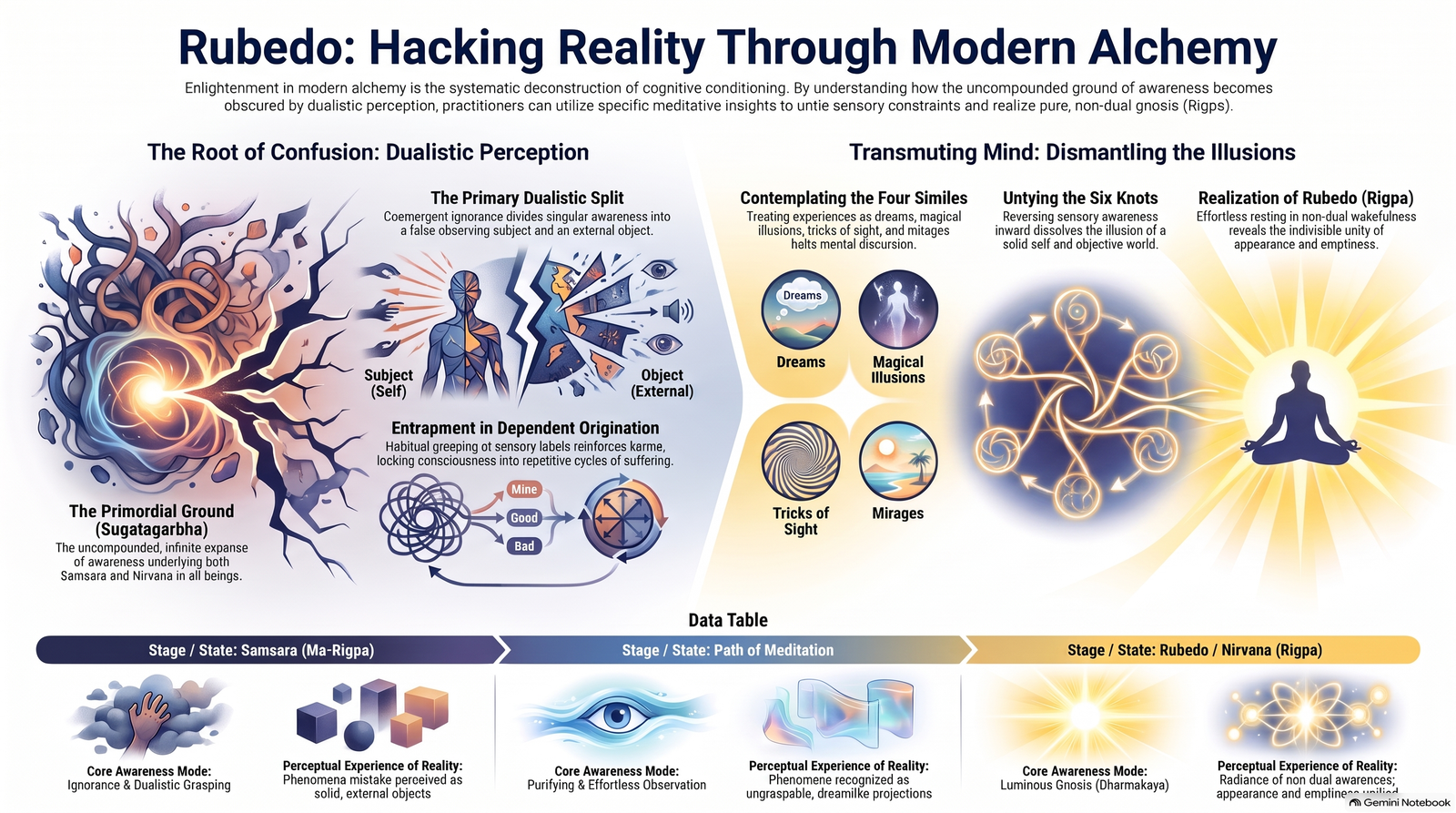
Companion infographic
Glossary
Nigredo, Albedo, Citrinitas and Rubedo
These Latin alchemical names refer to blackening, whitening, yellowing and reddening. Historical alchemical authors varied in their use and ordering of colour changes. Robinson uses the four names for descent, clarification, solar insight and the expression of insight in embodied life.
Retort and prima materia
A retort is a vessel used in distillation. Prima materia, or first matter, has varied meanings in alchemical writing. The hosts use the vessel and its contents to picture attention to habits that are easy to disown. This metaphor leaves room for the real effects of other people, circumstances and harm.
Nonduality and rigpa
Nonduality can name a questioning of the assumed separation between the knower and what is known. In Dzogchen, rigpa often refers to recognition or knowing of the nature of mind. The graphic borrows this vocabulary for the course’s symbolic map. These terms have specific uses within Buddhist traditions.
The Tigris, Euphrates and the Blind King
Genesis names the Tigris and Euphrates among four rivers associated with Eden. The hosts use Robinson’s associations with Hod and Netzach, two sefirot on the Kabbalistic Tree of Life, to dramatise analysis and felt continuity. The Blind King is their image for analysis that has lost sight of its limits.
Spindle of Necessity and karma
The spindle is a cosmic image in Plato’s Myth of Er. The story combines the ordering of lives with responsibility for choosing. In Buddhism, karma centrally concerns intentional action and its consequences. The recording uses one to illuminate the other, across separate philosophical and religious traditions.
Dharmakāya
Literally “Dharma body”, this Mahāyāna term has several doctrinal uses, including the Buddha considered in terms of ultimate reality. The episode compares it with the light in Plato’s story. The comparison belongs to the course’s reading of the myth. Plato develops the image within his own account of cosmic order.
Skandhas and the “skandha demons”
The five aggregates are form, feeling, perception, formations and consciousness. The late sections of the East Asian Śūraṅgama Sūtra organise fifty meditative deviations in relation to them. The recording reads them psychologically as occasions for misreading experience and claiming distinction. The source text also uses religious and cosmological language.
Similes of illusion and emptiness
Dreams, mirages, echoes and other similes in Buddhist teaching explore how something can appear convincingly while depending on conditions. Emptiness here concerns the absence of inherent, independent existence. The examples leave intact the ordinary consequences of conduct and the difference a response makes to another person.
The engineer’s resignation
Robinson’s phrase names the point at which the wish to stand outside experience and repair it begins to look like part of the problem. The hosts use it to turn from compulsive self-improvement towards participation. Planning, judgement and dependable care all remain available within that account.
Good thoughts, good words and good deeds
The threefold formula expresses a Zoroastrian ethical ideal. It has an Avestan textual history, with an early instance in the Yasna Haptaŋhāiti. The hosts use it to give practical direction to the return to daily life.
Saṃsāra and nirvāṇa
Saṃsāra names the Buddhist cycle of conditioned existence and rebirth, and nirvāṇa names liberation. The episode’s closing image of the same tomato draws on a nondual reading within the course. Traditions formulate their relationship in different ways. The distinction between suffering and liberation remains ethically significant.
Related pathways
- Citrinitas – Part Three places the yellowing in the context of the course.
- 3.2.11. Returning to Saṃsāra explores the question of returning to the world of suffering.
- 3.3.10. Beyond Duality gives the course’s account of emptiness and nonduality more room.
- 3.2.2. The Six Knots provides context for the separate teaching named in the infographic.
- Rubedo – Part Four introduces the red work within the website’s course structure.
External reference points
- Genesis 2:10–14, New American Bible, Revised Edition gives the biblical account of the four rivers.
- Plato’s Republic, Book X, 614b–621d, translated by David Horan (PDF) gives the Myth of Er in context, including the spindle and the choice of lives.
- The Śūraṅgama Sūtra on the fifty skandha states, Buddhist Text Translation Society (PDF) gives the East Asian text’s religious context for the episodes the hosts read psychologically.
- Humata Hūxta Huvaršta, Encyclopædia Iranica traces the Zoroastrian formula for good thoughts, words and deeds.
Question to carry forward
Which ordinary responsibility is asking for your attention today, and what would taking care of it well look like?