
Dialogues V · Episode 16
Are You the Sky or the Storm? | Dialogues V
A moment of recognition can change how we understand the storm while the body is still weathering it.
The central question
What changes if awareness is already free?
If even heaven depends on conditions that eventually change, what could liberation mean? The episode opens with a deliberately exaggerated image of a celestial bank account running dry. In Buddhist cosmology, heavenly rebirth belongs to saṃsāra, the cycle of rebirth, and even very long lives in heavenly realms are impermanent. The image also raises a question closer to home. When a pleasure, achievement or period of calm depends on circumstances, how much lasting security can it offer?
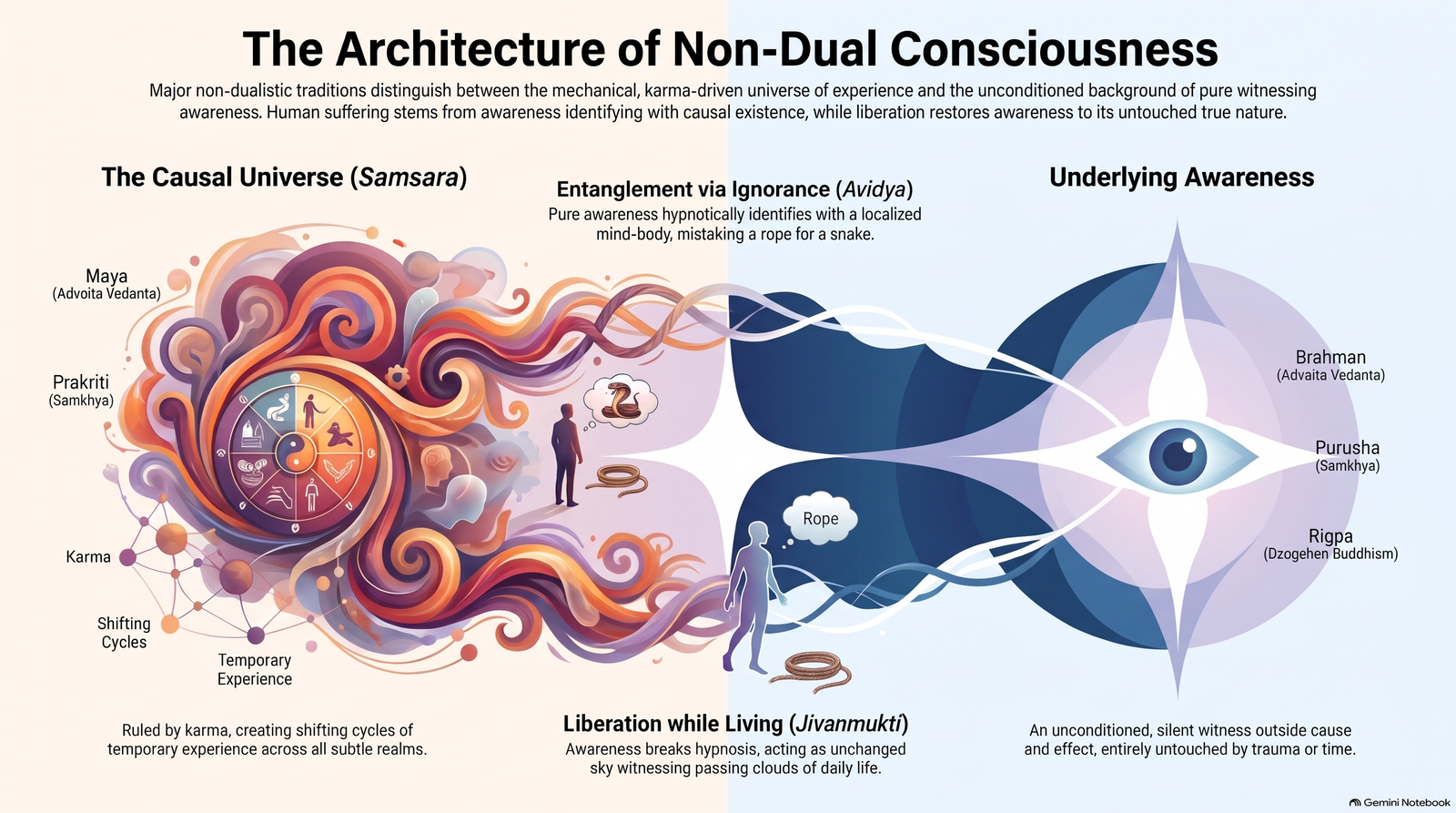
The hosts then examine a difficulty within their own framing. If awareness and the world of appearances are described as two realities, in what sense is the account non-dual? The clay and pot give the Advaita Vedānta answer a shape. A pot has an everyday use and a recognisable form, yet depends on clay. The conversation brings in Kashmir Śaivism to ask how multiplicity might be understood as an expression of consciousness itself. Its comparisons then reach classical Sāṃkhya, which distinguishes many witnessing consciousnesses from nature, and Dzogchen, a Tibetan Buddhist tradition in which the recognition of rigpa has its own doctrinal setting. The images can be compared even where the accounts of reality diverge.
The mirror brings the argument to its hardest point. A reflection of fire can appear in a mirror without being a fire in the glass, yet the person who mistakes a rope for a snake can feel genuine fear. Even after the room is lit and the mistake is clear, the person may still be shaking. The dialogue is most precise here when it gives recognition and bodily reaction different timescales. The rope story shows how one mistaken perception can matter. Ordinary suffering can also arise from real danger, loss and injury.
The open sky brings the inquiry back into daily life. The hosts ask what could change in the way someone cares for others, grieves or keeps an ordinary commitment when a passing state has less authority over their sense of who they are. Within the episode’s hypothesis of an unchanging awareness, this leads to the closing puzzle. If awareness was never bound, what changes when a person seeks or experiences liberation?
Argument map
Six movements through the episode
Even heaven changes
An impermanent heaven tests whether any experience produced by conditions can provide lasting freedom.
What makes two realities?
The clay and pot show how an Advaita account can recognise everyday appearances within a non-dual view.
Why the wheel keeps turning
The three poisons illustrate how misrecognition, grasping and aversion sustain the patterns the hosts associate with saṃsāra.
What the mirror reflects
The hosts compare different accounts of awareness and use the unstained mirror to picture experience without complete identification.
A mistake can leave real fear
Recognising the rope corrects the perception while the body may still be responding to a threat it had expected.
What could be liberated?
The sky metaphor leads from continued participation in ordinary life to the puzzle of what changes if awareness is already free.
Chapters
Each chapter opens at that point on YouTube in a new tab.
- 00:00Why Even Heaven Cannot Last
- 03:41Two Realities and the Non-Dual Paradox
- 07:11The Causal World and the Three Poisons
- 12:29Why Heaven Remains Within Samsara
- 16:09What Māyā Actually Means
- 18:33Underlying Awareness Across Traditions
- 21:20The Mirror That Cannot Be Stained
- 24:13Why Suffering Still Feels Real
- 27:08The Rope, the Snake and the Conditioned Body
- 31:26Liberation and the Open Sky
- 35:01Living Fully Within the World
- 39:23Does Awareness Need Liberation?
Glossary
Saṃsāra
Often translated as “wandering”, saṃsāra refers here to the Buddhist cycle of birth, death and rebirth. Its scope includes heavenly as well as painful realms. The episode also applies the wheel to repeated patterns in everyday life, giving a psychological reading of a term with a wider cosmological meaning.
Dependent origination
A Buddhist teaching about how phenomena arise and cease in dependence on conditions. In the episode, its relevance is the way ignorance, feeling, craving and clinging can sustain suffering. The traditional teaching concerns specific relationships among conditions and gives a more precise account than the broad slogan that everything is connected.
Karma (Pāli kamma)
In an early Buddhist account, karma centres on intention expressed through body, speech and mind. The episode’s bank account and video game help convey its account of action and consequence. The source teaching distinguishes an intentional action from its results, and ordinary causation includes much more than karma.
The three poisons and the wheel of life
In many Tibetan Buddhist depictions of the wheel of life, or bhavacakra, a pig, a bird and a snake stand for delusion, attachment and aversion. The episode brings those symbols into an ordinary workplace to illustrate how taking a role or reputation as fixed can drive grasping and defensiveness.
Brahman
In Śaṅkara’s Advaita Vedānta, brahman is the non-dual reality on which the world of plurality depends. The tradition identifies it with the deepest sense of self, ātman. The clay-and-pot comparison conveys this dependence. Brahman and Brahmā, a deity in Hindu traditions, are different terms.
Māyā
A Sanskrit term whose meanings vary by text and school. In the Advaita discussion here it concerns how a differentiated world appears and can be taken as independently real. The episode’s ruler and ocean illustrate the idea of imposing divisions. “Creative measurement” is the episode’s interpretive gloss, while the cited Advaita account distinguishes everyday experience from ultimate reality.
Spanda
Often rendered as “pulsation” or “throb”, spanda names a teaching in Kashmir Śaivism about the dynamism of consciousness. The hosts use it to describe multiplicity as an expression of consciousness. In this context, “vibration” is doctrinal language for that dynamism and has a different sense from measurable physical vibration.
Puruṣa and prakṛti
Classical Sāṃkhya distinguishes puruṣa, witnessing consciousness, from prakṛti, nature, which includes thought and sensation as well as matter. The school recognises many puruṣas and an independent prakṛti. This makes it a dualist system, even though its language of witnessing offers a point of comparison with Advaita Vedānta.
Rigpa
Often rendered “intrinsic awareness” in Dzogchen, a Tibetan Buddhist tradition, rigpa concerns the recognition of the nature of mind. The mirror and sky are images the hosts use to approach this idea. The comparison with Brahman or puruṣa leaves open substantial differences about selfhood, appearance and liberation.
Avidyā
Usually translated as “ignorance”, avidyā in the Advaita passage refers to a fundamental misapprehension of self and reality. The rope mistaken for a snake illustrates how a mistaken reading can obscure what is present. Buddhist uses of the term belong to their own accounts of ignorance as a condition of suffering and rebirth.
Saṃskāra
A term with several uses in Indian traditions, including dispositions or impressions shaped by past experience and action. The episode’s oil tanker pictures why a habitual reaction may keep going after someone changes their interpretation. That analogy gives a way to imagine momentum. The Sanskrit term also has specific meanings in Buddhist analyses of mental formations.
Mokṣa, nirvāṇa and jīvanmukti
Mokṣa is a broad term for liberation in Indian traditions. Buddhist nirvāṇa is taught in relation to the cessation of craving and suffering. Jīvanmukti means liberation while living, especially in Vedānta discussions. The episode brings all three into its closing inquiry, where their distinct accounts of freedom still matter.
A one-minute reflection
Notice what changes
While doing something ordinary, such as setting down a cup, notice a passing thought about what comes next. If it helps, phrase it as “I’m thinking about the next thing”. Feel the cup in your hand and finish setting it down. What changes, if anything, when you can notice a thought and still give the small action your attention?