
Nigredo · Subject · Chapter 47
Establishing the Way
Direction becomes trustworthy when it no longer depends on excitement, identity or applause, but begins to shape ordinary conduct.
Watch the chapter discussion
When the Path Starts to Flow Naturally
How to approach the model
The recording combines autobiography, Theravāda Abhidhamma, alchemical symbolism and contemporary psychological analogy. It is strongest as an account of how insight might become embodied through routine, service and restraint. Its technical claims about consciousness require qualification, and its descriptions do not confirm attainment or provide a clinical assessment of altered mood, trauma, dissociation or distress.
Brief book orientation
When direction becomes embodied
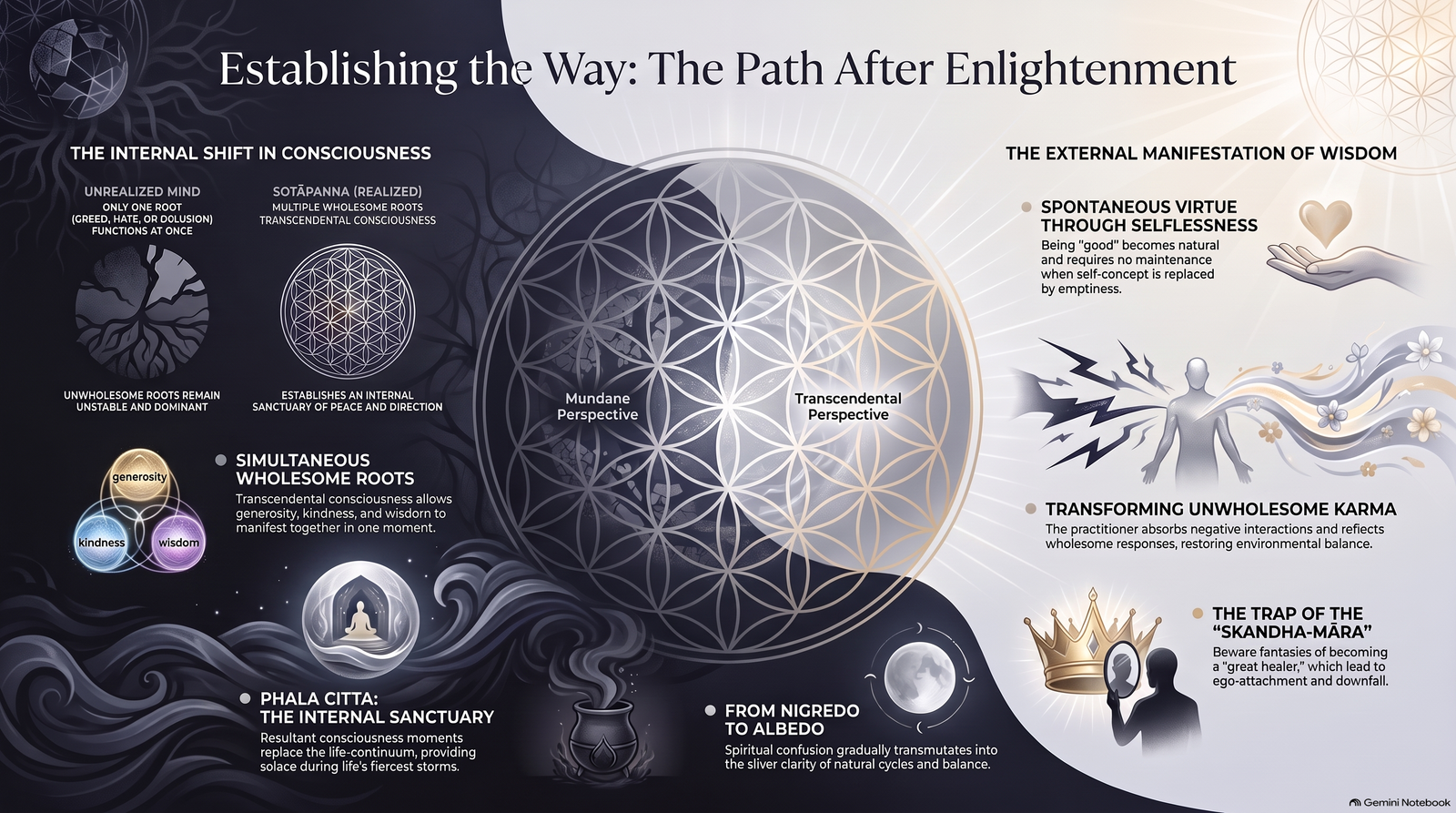
The written chapter asks what changes when a path begins to establish itself after an initial breakthrough. Intellectual certainty remains limited, yet an instinctive direction gradually appears. Dr Robinson interprets this through the Theravāda language of path and fruition consciousness, then places it beside an autobiographical return from isolation, professional loss and intense creative work.
The chapter’s practical centre is the movement from self-conscious goodness towards less possessive service. Alchemical multiplication and the transition towards Albedo symbolise the return of insight to ordinary life. The final warning is equally important: helpfulness, unusual confidence or influence can be appropriated by a new spiritual identity. Humour, vigilance and humility therefore remain part of the way.
The central tension
Can goodness flow without becoming “my goodness”?
Direction precedes explanation
The author describes a long interval in which conduct and instinct changed before the intellect could organise the experience into a stable account.
Structure can carry a fragile life
Writing, walking and a strict routine supplied temporary scaffolding after older ambitions and professional identity had lost their force.
Service supplies practical purpose
When self-definition weakens, helping others can become a grounded direction. It remains ethical only when care includes reality, consent, safety and appropriate boundaries.
Achievement can rebuild identity
The moment a helpful act becomes evidence of being a healer, prophet or exceptional person, the old structure of possession may return in spiritual form.
The recording’s argument
From disorientation to a quieter authority
Let instinct mature
The opening distinguishes embodied reorientation from the accumulation of concepts. A new way of responding may become visible before it can be fully explained.
Use the map carefully
Citta, mental roots, path, fruition and life-continuum offer a precise Theravāda vocabulary, but the recording sometimes turns technical categories into broader metaphors for an inner sanctuary.
Build temporary scaffolding
During a period of profound uncertainty, bounded projects and bodily routine can restore sequence and contact with ordinary life. Intensity alone does not establish whether a period is spiritual, creative or clinical.
Return through service
The chapter’s alchemical multiplication is a descent back into material life. Purpose is recreated through useful action rather than a renewed search for status.
Observe cause and consequence
Continuous mindfulness reveals how greed, hatred and delusion condition suffering. The value of the model lies in seeing reactions clearly enough for a less harmful response to become possible.
Move towards Albedo
Silver and moonlight symbolise receptivity and clarification. The recording describes meeting hostility without automatically returning it, a psychological circuit-breaker rather than a supernatural transfer of karma.
Recognise the beautiful demon
Grand fantasies can appropriate real usefulness. Claims of special healing power, coercion, secrecy and immunity from criticism are warning signs, not evidence of higher attainment.
Remain an ordinary observer
The closing image is not withdrawal from life but participation without trying to make a permanent home from changing conditions. Confidence becomes quieter as ownership loosens.
A necessary doctrinal note
Where the Abhidhamma model needs precision
The chapter’s presentation is a personal synthesis rather than a standard technical summary. In Theravāda Abhidhamma, a single citta is accompanied by multiple mental factors. Unwholesome cittas may be rooted in greed and delusion together, or hatred and delusion together; wholesome sense-sphere cittas normally have the two roots of non-greed and non-hatred and may also be accompanied by non-delusion. Simultaneous wholesome roots are therefore not unique to stream-entry.
Magga and phala cittas are supramundane path and fruition moments in the commentarial model. Fruition follows the path moment, but it does not permanently replace every subsequent bhavaṅga, or life-continuum, during ordinary waking life or sleep. Describing fruition as a lasting “internal sanctuary” can be evocative, but it should be read as the author’s experiential metaphor rather than the formal mechanism itself.
The recording’s AI narration also mispronounces or mistranscribes several Pāli terms. This page uses the standard forms: citta, phala, magga, bhavaṅga, sotāpanna, vipassanā, Nigredo and Albedo.
Sources and boundaries
What each layer contributes
| Layer | Contribution | Boundary to retain |
|---|---|---|
| The written chapter | An autobiographical account of direction emerging through confusion, routine, service, mindfulness and increasing confidence. | Retrospective interpretation through Buddhist path stages is not independent confirmation of attainment or a universal sequence after insight. |
| Theravāda Abhidhamma | A detailed analysis of momentary consciousness, associated mental factors, roots, path, fruition and the life-continuum. | The chapter simplifies and at points misstates the technical model. The page retains its intended contrast while correcting claims about roots and bhavaṅga. |
| Alchemical symbolism | Multiplication, silver, moonlight, Nigredo and Albedo picture insight returning to embodied life and becoming useful within relationship. | These are course metaphors. They do not establish a scientific energy transfer, physical healing mechanism or necessary psychological stage. |
| Autobiographical reflection | The loss of a medical career, contained hyper-productivity, walking and writing show how external structure may support a disoriented life. | The author’s retrospective use of “mania” is descriptive, not a diagnosis. Sleeplessness, grandiosity, severe agitation or impaired functioning warrant appropriate clinical attention. |
| Karmic transmutation | The recording imagines receiving hostility without reproducing it, then returning patience, clarity or non-hatred to the situation. | In Buddhist teaching, karma principally concerns intentional action and its results. One does not literally absorb another person’s karma like a transferable substance. |
| Spiritual identity | Skandha-māra, the “beautiful demon”, names the danger of rebuilding selfhood around insight, influence or the role of healer. | Claims about another person’s realisation cannot be inferred from charisma, helpfulness or downfall. Safeguards include accountability, transparency, consent and the freedom to question authority. |
| Joylessness | The chapter uses the term for freedom from possessive emotional highs and comparison, making appreciative joy for others less entangled with envy. | This is not a standard prescription to eliminate joy. Persistent anhedonia, numbness or depression should not be romanticised as equanimity or awakening. |
Video chapters
Navigate the discussion
- 00:00Opening: When the Path Feels Natural
- 02:10From Confusion to Instinct
- 06:00How Behaviour Begins to Change
- 10:20Wholesome Roots and Consciousness
- 15:10The Inner Sanctuary (Phala Consciousness)
- 20:00Routine, Work, and Stabilisation
- 25:30From Identity to Service
- 30:40The Danger of Spiritual Identity
- 35:20Becoming an Observer of Life
- 39:10The Path Establishes Itself
Working vocabulary
Terms used in the chapter and recording
Citta
Roots (hetu)
Sotāpanna
Magga and phala
Bhavaṅga
Vipassanā
Multiplication
Nigredo and Albedo
Skandha-māra
Muditā
Integration
Continue within the course
Related pathways
- 1.4.10. First StepsThe preceding Subject chapter explores the first return to ordinary tasks, relationships and ethical practice after a decisive insight.
- Chapter 48 video: When the Darkness Finally LiftsThe final Nigredo recording continues from an established direction towards the course’s concluding movement out of blackening.
- 1.3.7. Path ConsciousnessProvides the course’s fuller introduction to the path moment used in Chapter 47’s account of realisation.
- 1.3.8. SotāpannaPlaces stream-entry within the traditional four-stage map invoked by both the written chapter and recording.
- 1.2.4 ConsciousnessReturns the discussion to the course’s foundational treatment of consciousness before the more technical Abhidhamma vocabulary.
- 1.2.12. The Eightfold Noble PathGrounds direction in an integrated framework of understanding, intention, speech, action, livelihood, effort, mindfulness and concentration.
- Albedo – Part TwoThe next part of the course develops the whitening and clarification that this chapter approaches symbolically.
Reference points
For careful further reading
- Stanford Encyclopedia of Philosophy: AbhidharmaAn academic overview of momentary consciousness, mental factors and the systematic analyses developed by Buddhist scholastic traditions.
- A Comprehensive Manual of AbhidhammaBhikkhu Bodhi’s guide to the Theravāda compendium, useful for checking the classification of rooted cittas, cognitive processes, path and fruition.
- SuttaCentral: SN 55.25An early Buddhist statement distinguishing stream-entry from once-return through the ending of three fetters and the weakening of greed, hate and delusion.
- SuttaCentral: AN 6.39, SourcesA concise early teaching on greed, hate and delusion as sources of action, and on their wholesome counterparts.
- Shunryu Suzuki, Zen Mind, Beginner’s Mind (1970)
The source identified by the written chapter for its opening reflection on harmonising the inner and outer worlds.
A grounded experiment
Interrupt one reaction
Choose one mild, ordinary moment of friction today: a delayed reply, a small criticism, an inconvenient request or a task that feels thankless. Before responding, notice the first impulse to defend an identity, prove goodness or return the same emotional charge. Take one breath and choose the least harmful truthful response available, including a clear boundary or no immediate response. Afterwards, ask whether anything was “absorbed”, or whether a conditioned sequence was simply not continued. Do not use this exercise in an unsafe situation, and do not treat exhaustion, numbness or tolerance of mistreatment as spiritual maturity.
Course navigation