
Nigredo · Subject · Chapter 42
Confusion
What happens when a life-changing experience weakens the old centre of motivation before a workable new orientation has formed?
Watch the chapter discussion
Why Everything Feels Confusing After Awakening
Chapter guide
Follow the edited discussion
- 00:00What Happens After a Breakthrough?
- 02:43“In My Beginning Is My End”
- 03:34Becoming Uncaught
- 06:05Why Contemplative Context Matters
- 09:41The Dark Void and White Geometry
- 13:24Four Changes After the Experience
- 16:52The Collapse of Conventional Motivation
- 18:44Five Years in the Twilight Zone
- 21:38The Glitching Mind
- 21:59Acting for Others Without Self-Interest
- 24:20Jhāna and the Beginning of Integration
- 26:12Is Ordinary Consciousness Only One Mode?
- 27:10The Cost of Dissolving the Self
- 28:41What Remains When the Seeker Disappears?
Brief book orientation
After the moment that divides before from after
The written chapter is a first-person account of an experience Dr Simon Robinson later interpreted through Theravāda Buddhist ideas of stream-entry. It contrasts a brief, expansive breakthrough with a far longer aftermath: former goals lose their force, decisions become difficult, self-description feels empty and an undefined search replaces ordinary motivation.
Within Nigredo’s Subject section, this is the point at which dramatic insight gives way to the practical problem of living. The chapter presents the author’s retrospective interpretation, including his later study of Abhidhamma and jhāna; it does not establish that the same sequence follows every contemplative experience or independently confirm a traditional attainment.
What the recording explores
When insight and functioning move at different speeds
The recording asks an unusually practical question: if a transformative experience loosens the self that supplied preferences, ambitions and a continuous life story, how does ordinary choice continue? It begins with the chapter’s image of becoming “uncaught” – awareness no longer organised around a single personal perspective – and treats the event as a sharp division between a former life and an unfamiliar mode of experience.
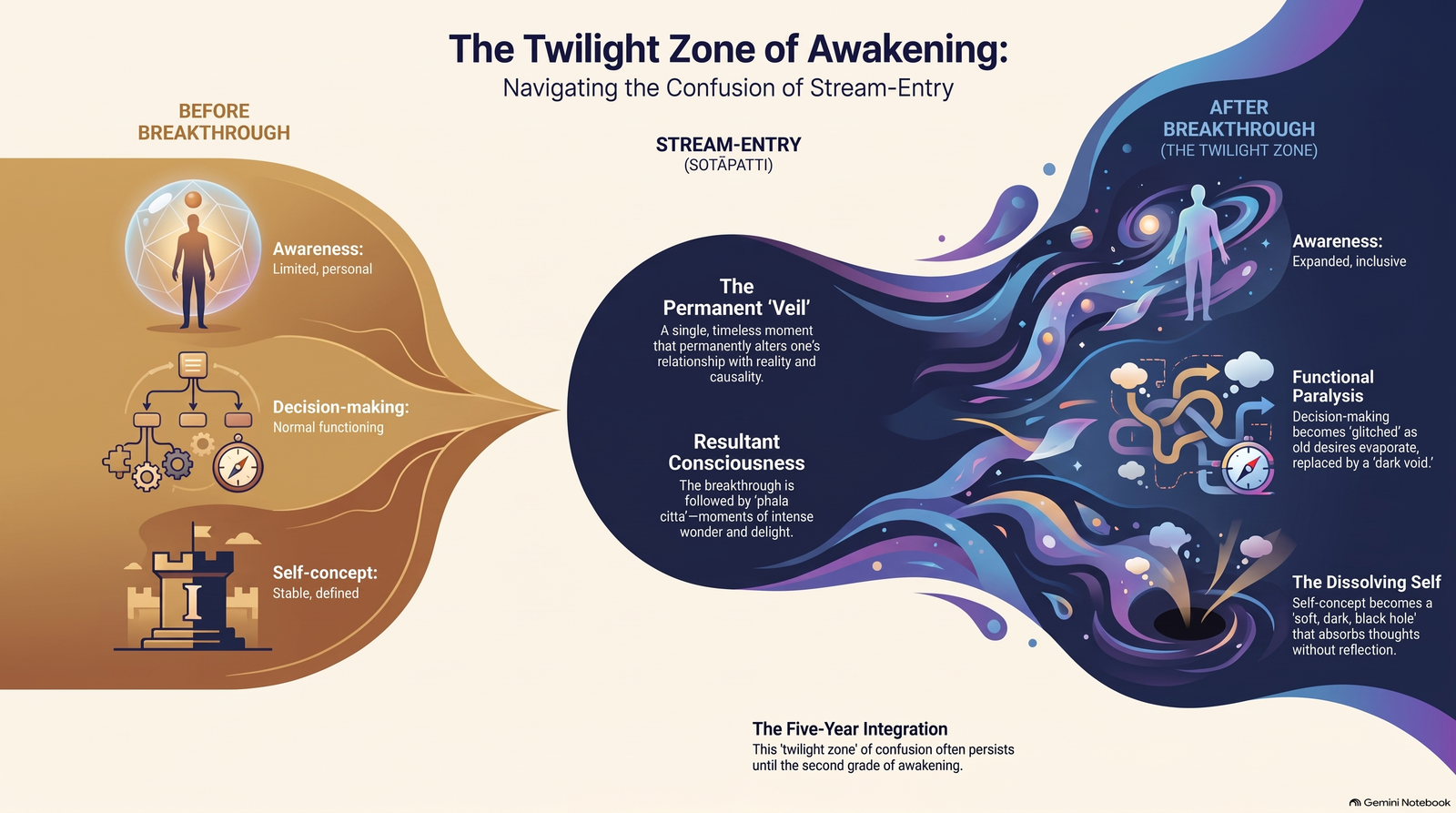
The discussion then moves from the event to its consequences. A visual contrast between a dark sphere and precise white geometry becomes a metaphor for the reported aftermath: thoughts and self-directed wishes seem to fall into an inner void, while experience still appears ordered at an impersonal level. The chapter’s four-part table gives the inquiry its structure: awareness changes from personal to inclusive; decision-making from ordinary to paralysed; motivation from conventional goals to undefined seeking; and self-concept from stable to dissolving.
The most valuable part of the recording is its refusal to make this immediately attractive. The author’s five-year “twilight zone” is associated with indecision, withdrawal from shared priorities and hurt to loved ones. Yet the recording also notices an apparent exception: energy remained available for tasks that did not centre the author’s own wants. It interprets later jhāna practice and study as part of a gradual integration, although the stronger claims about brain networks, dopamine, “objective awareness” and meditation rebuilding neurological scaffolding go beyond the supplied chapter and evidence.
The closing question is therefore not whether confusion proves awakening. It is how any powerful shift can be interpreted, supported and integrated without romanticising incapacity, abandoning ordinary responsibilities or forcing spiritual and clinical explanations into a false choice.
A contemplative interpretation is not a differential diagnosis
The chapter reports an experience and the meaning its author later gave it. Loss of motivation, impaired decision-making, depersonalisation, derealisation, depression, mania and psychosis can overlap in language while differing greatly in cause, course and risk. They are not “phenomenologically identical”, and seeking medical or psychological assessment does not amount to rebuilding a false ego. Persistent functional decline, loss of reality testing or danger to self or others deserves prompt professional help alongside any careful contemplative guidance.
Argument map
From breakthrough to the work of integration
Question the promised clarity
The recording opens by challenging the assumption that profound insight simply makes the existing person calmer, clearer and more effective.
Enter the reported event
“Uncaught” awareness is described as expansive, uncentred and difficult to place within the author’s earlier secular outlook.
Read the visual metaphor
The dark void and white geometry give imaginative form to dissolving self-reference and a remaining sense of impersonal order.
Measure the everyday cost
Changes in awareness, choice, motivation and identity turn an exalted-sounding event into a problem of work, relationships and basic direction.
Distinguish self-interest from energy
The author’s capacity to act for others complicates the idea that personal ambition is the only possible source of effort.
Seek context and integration
Later Buddhist study and formal meditation provide the author with a map, but the recording’s causal and neurological explanations remain interpretive.
Release the triumphant ending
The episode closes by asking what remains when the seeker itself is no longer experienced as the stable owner of the path.
Visual synthesis
Before and after the reported breakthrough
The infographic organises the chapter’s contrast across awareness, decision-making, motivation and self-concept. It is a visual summary of one autobiographical account, not a diagnostic instrument, an attainment test or a universal sequence.
Book and recording
What each layer contributes
| Layer | What it contributes | Boundary to retain |
|---|---|---|
| The written chapter | A concise autobiographical account of a reported breakthrough, the confusion that followed and a later interpretation through Theravāda path language. | First-person testimony establishes what the author recalls and believes it meant; it does not independently verify stream-entry or generalise the sequence to others. |
| The AI-generated recording | A vivid functional analysis of lost preference, the “glitching” mind, the four before-and-after contrasts and the strain placed on ordinary relationships. | Its claims about the default mode network, cortisol, dopamine, evolutionary psychology and brain-wave synchronisation are rhetorical extrapolations, not findings established by this account. |
| Theravāda vocabulary | Sotāpatti, phala citta, sakadāgāmī, Abhidhamma and jhāna provide the traditional map through which the author later understood the experience. | Meanings and criteria belong to a disciplined religious tradition. A modern autobiographical comparison should not be treated as institutional recognition of attainment. |
| Clinical comparison | The account usefully shows that unusual contemplative experiences may be distressing, impairing or difficult to explain within a person’s existing worldview. | Spiritual and clinical interpretations are not mutually exclusive. Similar words do not make distinct conditions identical, and appropriate assessment should not be delayed. |
| Philosophical conclusion | The recording asks whether ordinary ego-centred consciousness is one mode of organising experience rather than the only imaginable one. | That is a philosophical and phenomenological proposal. The narrative does not prove a single “objective awareness” beneath conditioning or overturn cognitive science. |
Working vocabulary
Terms used in the chapter and recording
Breakthrough
Sotāpatti and sotāpanna
Path and fruition consciousness
Abhidhamma
Sakadāgāmī
Jhāna
Non-dual awareness
Self-concept
Depersonalisation and derealisation
Default mode network
Integration
Phenomenology
Continue within the course
Related pathways
- 1.4.5. The NightThe preceding Subject chapter confronts inner division and the difficulty of meeting what a defended identity has excluded.
- Chapter 43 video: Why You Must Stay Grounded After AwakeningThe next recording turns from confusion towards commitment, grounding and a workable orientation in ordinary life.
- 1.3.7. Path ConsciousnessIntroduces the Theravāda analytical framework later used to interpret the reported breakthrough.
- 1.3.8. SotāpannaExamines the first traditional grade of realisation without reducing it to a single unusual experience.
- 1.3.9. SakadāgāmīProvides the course context for the second grade that the chapter associates with later confidence and stability.
- 1.3.6. Different Worlds and JhānaExplores meditative absorption and altered modes of experience within the wider Nigredo map.
Reference points
For careful further reading
- SuttaCentral: Discourses on Stream-Entry (SN 55)Primary-text context for stream-entry, including the qualities and conditions associated with it in the Pāli discourses.
- Lindahl and colleagues: The Varieties of Contemplative ExperienceA mixed-methods study of challenging, distressing or impairing meditation-related experiences among Western Buddhist practitioners.
- US National Center for Complementary and Integrative Health: Meditation and mindfulnessA cautious overview of evidence, limitations and safety rather than a claim that meditation is uniformly beneficial or risk-free.
- NHS: Overview of psychosisClinical information that helps distinguish loss of reality testing from a purely symbolic or contemplative description.
- NHS: Where to get urgent help for mental healthCurrent UK routes to urgent support when confusion, distress or risk cannot safely wait.
Question to carry forward
What needs interpretation, and what needs support?
If an experience has changed your sense of direction, make two short lists. In the first, note the meanings you are considering. In the second, note observable changes in sleep, eating, work, relationships, safety and decision-making. Holding both lists together allows philosophical openness without losing contact with ordinary functioning. If there is serious impairment, loss of reality testing or risk, seek appropriate professional help rather than using the exercise to decide whether an attainment has occurred.
Course navigation