
Nigredo · Subject · Chapter 44
Spiritual Orientation
A spiritual breakthrough may last only moments. Learning how to live after it can take years.
Watch the chapter discussion
What Happens After a Spiritual Breakthrough?
Chapter guide
Follow the edited discussion
- 00:00Radical Honesty and the Inward Path
- 05:06Three Doors Into Insight
- 07:33The Personal Experience of Emptiness
- 08:52Awakening, Dissociation and Ego Panic
- 13:30The Once-Returner and the Weakening of Fetters
- 19:43Is Meditative Absorption Necessary?
- 21:20Music, Flow States and Everyday Jhāna
- 27:41Why Insight Needs an Ethical Foundation
- 32:39What Happens After a Breakthrough?
- 34:17Four Dimensions of Spiritual Integration
- 38:52Six Years of Withdrawal and Reorientation
- 40:52Insight Is Only the Beginning
Brief book orientation
When insight begins to provide direction
The written chapter describes a movement from the confusion following an initial breakthrough towards a firmer spiritual orientation. Dr Robinson recalls a brief but overwhelming certainty that the familiar “I” could not exist as he had assumed, and interprets the experience through the Theravāda category of sakadāgāmī, or once-returner. In the chapter’s account, the practical sign is not a new title but increasing resolve and a weakening of compulsive desire and ill-will.
Spiritual Orientation also argues that formal mastery of meditative absorption is not the only route to insight, while retaining ethics as indispensable. It ends with a long view: study, moral restraint, periods of withdrawal and the gradual relinquishment of older goals are said to have taken years to settle into a recognisable path. These are autobiographical interpretations placed within a Buddhist map, not independent confirmation of attainment.
What the recording explores
Insight changes direction before it changes everything
The replacement recording begins with Pema Chödrön’s description of self-ignorance as a fundamental aggression. It treats spiritual inquiry not as a comforting hobby but as the willingness to examine identity honestly and gently. The discussion then turns to three traditional characteristics through which insight may arise: emptiness (śūnyatā), impermanence (anicca) and the unsatisfactory nature of conditioned experience (dukkha).
The episode distinguishes intellectual agreement from a structural shift in perception. The author’s brief certainty that the conventional “I” could not exist as previously imagined is explored alongside the important possibility of dissociation, depersonalisation or psychological destabilisation. The recording does not treat disruption, unusual experience or loss of functioning as proof of awakening; orientation is tested through ethics, steadiness and the capacity to live responsibly.
Within the Theravāda map, the discussion moves from sotāpanna, or stream-enterer, towards sakadāgāmī, the once-returner. The second stage is presented not as the total removal of desire and ill-will but as their weakening. Old biological and emotional reactions may still arise, yet they need not organise the whole mind or dictate conduct.
The middle of the recording asks whether formal meditative absorption is indispensable. The written chapter proposes a broad understanding of “touching” first jhāna through music, study, reading or creative flow, while the recording clearly distinguishes this proposal from stricter traditional definitions of stable absorption. Attention alone is not enough: ethical conduct supplies the framework that prevents concentration or unusual insight from turning towards nihilism, temptation or grandiosity.
The closing movement concerns integration. A breakthrough can be followed by altered motivation, confusion, withdrawal and social misunderstanding. Four practical dimensions are considered: maintaining bodily routines, observing mental states without feeding their stories, protecting fragile insight through selective speech, and returning to ordinary ethical practice when the ego tries to turn insight into a special identity. The author’s six-year period of withdrawal and creative work illustrates the chapter’s central point: insight may be sudden, but reorientation is gradual.
A map, not a test of attainment
The written chapter and recording use traditional Buddhist categories to interpret changes in identity, motivation and spiritual direction. Terms such as sotāpanna, sakadāgāmī and jhāna have precise meanings within living traditions. A compelling personal experience does not independently confirm attainment, and disturbance should not automatically be spiritualised. This material is best approached as an inquiry into how insight might be integrated in ordinary life.
Argument map
From breakthrough to orientation
Look honestly inward
The path begins with the courage to examine experience rather than preserving a comforting account of who one is.
Recognise a door into insight
Emptiness, impermanence and suffering expose different weaknesses in the assumption of a fixed, independent self.
Distinguish insight from disturbance
Certainty or selflessness must be considered alongside functioning, stability and the possibility of dissociation or ego panic.
Understand gradual weakening
Desire and ill-will may continue to arise even when their underlying authority and capacity to dominate conduct begin to diminish.
Concentrate without romanticising
Music, study and creative flow may resemble absorption, but the chapter’s broad proposal should not be confused with formal mastery of jhāna.
Anchor insight in ethics
A moral framework gives attention and unusual experience a stable direction while guarding against temptation, nihilism and grandiosity.
Allow integration to take time
Routine, rational observation, selective silence and ordinary work help a changed orientation become livable rather than merely dramatic.
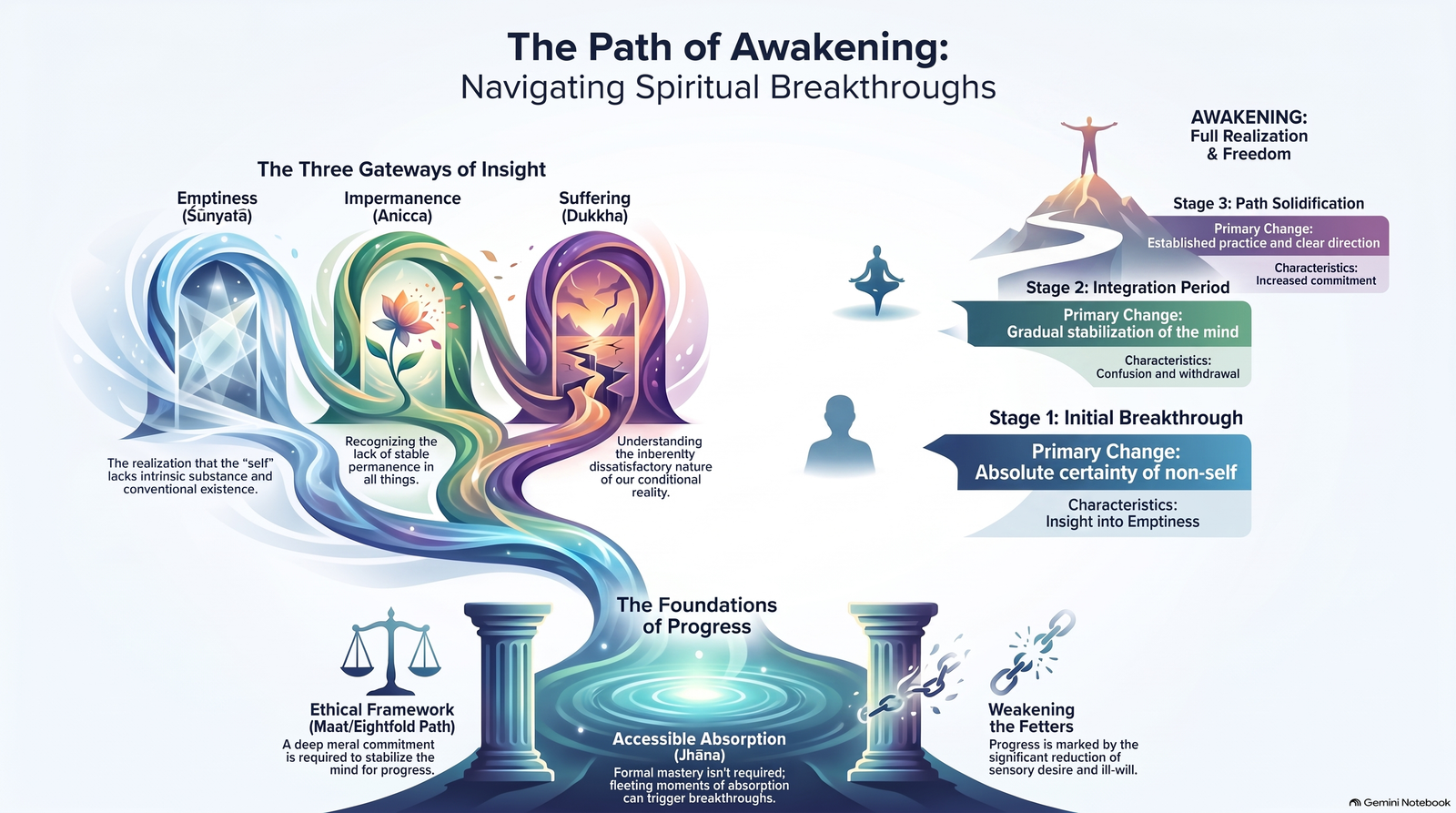
Visual synthesis
The path of awakening
The diagram offers a visual route through breakthrough, integration and changing orientation. It belongs to the author’s course map: it should be used for reflection and comparison, not as a diagnostic scale or a way of confirming spiritual status.
Book and recording
What each layer contributes
| Layer | What it contributes | Boundary to retain |
|---|---|---|
| The written chapter | A concise autobiographical account of a reported insight, the growth of resolve, the possible place of absorption and the ethical conditions thought to support progress. | The interpretation through sakadāgāmī is the author’s retrospective use of a Buddhist map, not external verification of attainment. |
| The AI-generated recording | A close exploration of radical honesty, the three doors into insight, the once-returner, absorption, ethics and four dimensions of integration. | The recording develops the chapter through contemporary psychological language and practical analogy. Those expansions should not be attributed wholesale to the concise book text. |
| Early Buddhist and Theravāda models | Anattā, the aggregates, fetters and four noble persons provide a disciplined vocabulary for analysing clinging and liberation. | These are tradition-specific teachings, not personality types, neurological stages or labels that can be confirmed from a short description. |
| Contemporary psychological interpretation | Dissociation, ego panic, narrative reinforcement and the regulation of ordinary routines help describe possible consequences of destabilising insight. | These analogies do not establish a clinical diagnosis or demonstrate that Buddhist path stages correspond to neurological or psychiatric categories. |
| Practical integration | Physical routine, rational observation, selective silence and continued ethical practice offer a grounded response to uncertainty after a breakthrough. | Severe distress, mania, dissociation, withdrawal or impaired functioning should not be assumed to be spiritual progress and may require professional support. |
Working vocabulary
Terms used in the chapter and recording
Spiritual orientation
Śūnyatā
Anicca
Dukkha
Sotāpanna
Sakadāgāmī
Jhāna
Pīti
Kāma-rāga
Vyāpāda
Maat
Selective silence
Integration
Continue within the course
Related pathways
- 1.4.7. CommitmentThe preceding Subject chapter places routine, restraint and humility between disorientation and a more settled spiritual direction.
- Chapter 45 video: No Self – Why the Ego Fights BackThe next recording continues the course’s examination of identity and the Buddhist teaching of not-self.
- 1.3.8. SotāpannaProvides the course’s fuller account of the first traditional grade used to interpret the author’s earlier breakthrough.
- 1.3.9. SakadāgāmīGives the immediate course context for the once-returner model central to the written chapter.
- 1.3.6. Different Worlds and JhānaPlaces absorption and altered modes of experience within the wider Nigredo map.
- 1.2.11. The Fetters that BindExplores the binding patterns used in the course to describe attachment, aversion and continuing identification.
Reference points
For careful further reading
- SuttaCentral: The Characteristic of Not-Self (SN 22.59)A primary-text presentation of the five aggregates as impermanent, unsatisfactory and not fit to be regarded as self.
- SuttaCentral: Stream-entry and once-return (SN 55.25)A concise early Buddhist formulation of stream-entry and the once-returner’s weakening of greed, hate and delusion.
- Pema Chödrön, When Things Fall Apart
The source of the chapter’s opening reflection on ignorance, courage and the gentle honesty required for inward inquiry. - SuttaCentral: The Simile of the Saw (MN 21)An early Buddhist teaching on training against ill-will even under severe provocation, relevant to the episode’s discussion of ethical restraint.
A question to carry forward
What supports insight when certainty fades?
Consider a change in understanding that arrived quickly but took much longer to live. Which ordinary supports helped it settle: routine, ethical restraint, careful observation, selective conversation, creative work or time? The question is about integration rather than spiritual status. If inquiry into identity contributes to distress, derealisation, mania, impaired functioning or loss of reality testing, pause and seek appropriate support.
Course navigation