
Nigredo · Object · Chapter 35 of 48
1.3.11. The Subtle Fetters
When the obvious forms of craving have quietened, what remains in attachment to refined existence, comparison, restlessness and the mind’s own way of constructing reality?
Watch the chapter discussion
The Final Illusions of the Mind
The book
The chapter in brief
This chapter turns from the five lower fetters abandoned at non-returning to the more refined attachments traditionally said to remain: passion for form, passion for the formless, conceit, restlessness and ignorance. It asks how clinging may persist when sensory desire and ill will no longer dominate, and why even serenity, spiritual identity or the wish for cessation can become objects of attachment.
Nigredo places this work at the threshold between Albedo and Rubedo. The white stone represents a profound restoration of balance, yet not the completion of the work; the red stone becomes the course’s image of final integration. This alchemical correspondence is Dr Robinson’s comparative synthesis. The fetter model, cosmological realms and arahant ideal belong to Buddhist traditions and should not be confused with empirically verified psychology.
Visual orientation
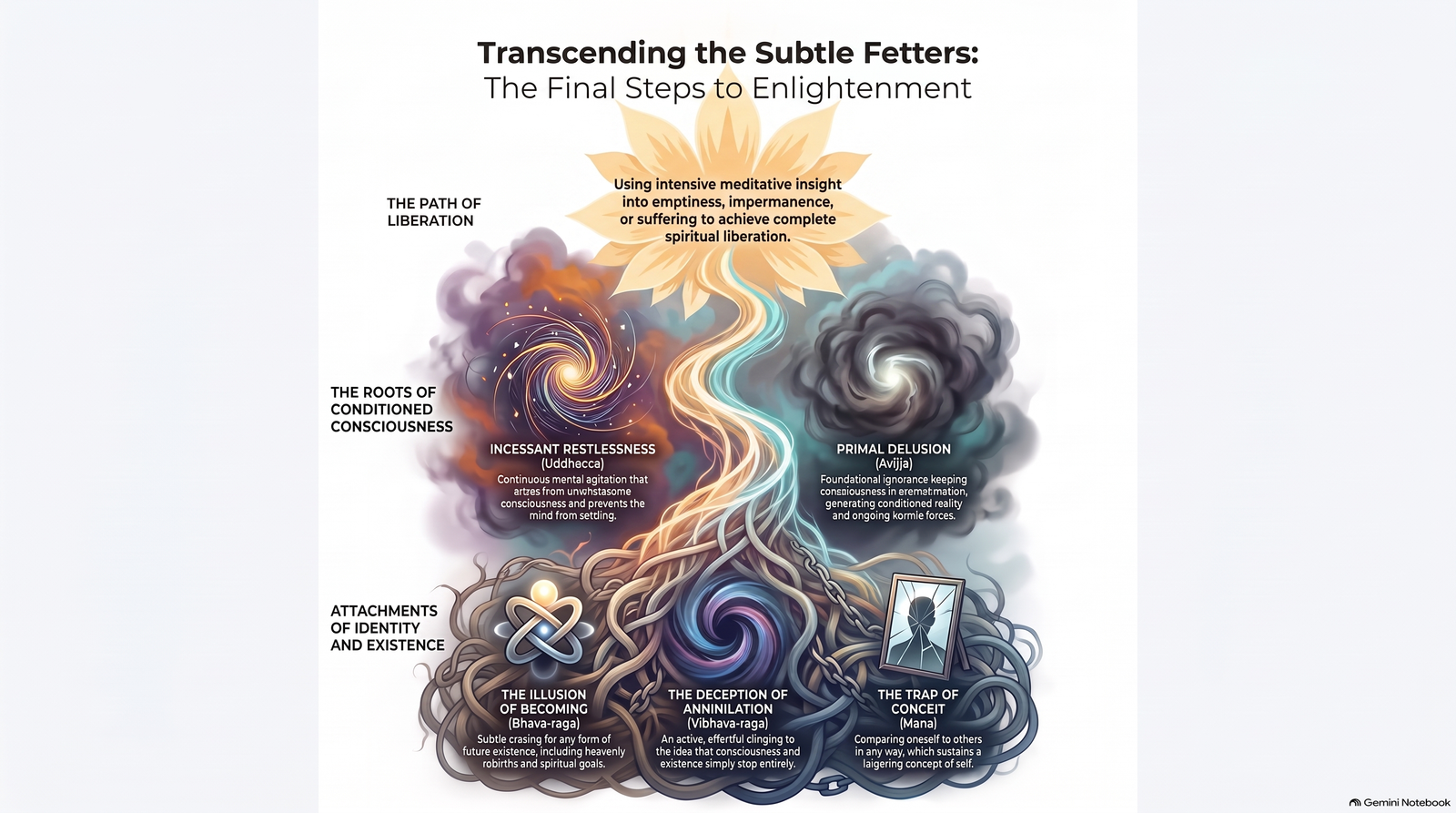
Transcending the subtle fetters
Video guide
From refined attachment to the root of knowing
The recording begins with an upward visual movement: dense matter, entangled roots, turbulent clouds and a flowering release. It reads this as a journey from sensory compulsion towards increasingly subtle forms of clinging. The image is a symbolic map rather than a diagnostic instrument. It cannot establish where another person stands on a path of awakening.
The first movement establishes the anāgāmī as the person confronting these higher fetters. The video describes the ending of sensory craving through contemporary language about dopamine and reward prediction. That translation may make the contrast with impulse control vivid, but it is not a neuroscientific definition of non-returning and no clinical marker for the attainment is known.
Alchemy then supplies a second framework. Albedo, silver, cooling and restored balance describe an apparently healed and socially functional life; Rubedo names a further transformation. The recording’s placement of “multiplication” before this transition belongs to the course’s symbolic architecture. It should not be presented as a historical consensus joining Buddhist path theory to one fixed twelve-stage alchemical sequence.
The central discussion is organised around becoming and annihilation. The wish to continue in some refined condition is treated as a nearly invisible forward lean, while the wish for experience to stop is treated as its mirror. These are useful contemplative themes, and bhava-taṇhā and vibhava-taṇhā are recognised forms of craving. They are not, however, the canonical sixth and seventh fetters in the standard ten-fetter list. Those are rūparāga, passion for form existence, and arūparāga, passion for formless existence.
The recording’s account of “non-percipient beings” and universe-long suspension belongs to traditional cosmology. Its computer-loop analogy is a modern explanatory image. The further comparison with scrolling or binge-watching may illuminate avoidance, but everyday distraction should not be equated with a specific rebirth destiny or used to pathologise ordinary rest.
Conceit is handled more precisely. Māna is not limited to arrogance; it includes measuring oneself as better, worse or equal. The warning that performed humility can preserve self-reference is psychologically useful. Yet abandoning conceit need not imply random conduct, indifference to consequences or the loss of a functional personality. Buddhist accounts retain ethical discernment and responsiveness rather than celebrating unpredictability for its own sake.
The last movement approaches restlessness and ignorance as conditions woven into cognition itself. Jhāna is presented as temporary suppression and vipassanā as active investigation through emptiness, impermanence and unsatisfactoriness. That contrast is too sharp if taken literally: Buddhist traditions describe varied relationships among calm, absorption and insight, and the three marks are ordinarily impermanence, unsatisfactoriness and not-self. Emptiness is closely related in many later traditions but should not silently replace anattā in an early-Buddhist formulation.
The video closes by contrasting active and passive routes to arahantship and repeating a claim that a lay arahant must ordain or die within seven days. This is not presented in the recording with a primary canonical source and should be treated as later traditional lore, not as a biological mechanism. The proposed explanation—that liberation removes the algorithms needed to keep the body alive—is speculative and not supported by medical evidence.
Argument map
How the recording develops
Follow the ascending thread
The opening artwork moves from dense sensory attachment through inner turbulence towards the image of release.
Locate the non-returner
The Anāgāmī is presented as free of the five lower fetters yet still bound by refined forms of clinging.
Pause at Albedo
Balance, silver and social reintegration appear as a profound but incomplete alchemical transformation.
Question spiritual striving
The Sāriputta story is used—though inaccurately in its details—to argue that forced attainment can obstruct the release it seeks.
Examine becoming
Hope for a future state is analysed as existential momentum, including attachment to refined rebirth or spiritual completion.
Examine annihilation
The wish for experience to cease is interpreted as an active construction rather than a simple absence of mind.
Remove the measuring stick
Conceit is expanded beyond pride to include inferiority, equality and the self-reference hidden inside performed humility.
Reach restlessness and ignorance
The final inquiry turns from explicit concepts towards the subtle agitation and misapprehension conditioning consciousness.
Set calm beside insight
Jhāna and vipassanā become complementary but differently emphasised ways of settling and investigating experience.
Move from white to red
Rubedo symbolises the course’s final transmutation, while the closing paradox asks whether craving for liberation can itself bind.
Book, tradition and interpretation
Four layers in the discussion
Five higher fetters EARLY BUDDHIST PATH MAP
Passion for form, passion for the formless, conceit, restlessness and ignorance are the standard higher fetters abandoned with arahantship.
Realms and rebirth TRADITIONAL COSMOLOGY
Pure Abodes, non-percipient beings and future liberation after death belong to Buddhist cosmological and soteriological accounts, not empirically verified geography.
Albedo to Rubedo ALCHEMICAL COMPARISON
The white and red stones allow the course to describe the difference between restored balance and a claimed completion of transformation.
Cognitive metaphors CONTEMPORARY INTERPRETATION
Servers, algorithms, code, dopamine, default-mode activity and infinite loops translate the argument into modern imagery without proving a neurological model.
Clarifying the model
The five higher fetters
| Higher fetter | Careful formulation | Chapter emphasis or caution |
|---|---|---|
| Rūparāga | Passion for refined form existence, commonly associated with form-realm attainment or rebirth. | The chapter’s broader “attachment to becoming” overlaps with this theme but does not precisely replace it. |
| Arūparāga | Passion for formless existence or formless attainments. | It is not simply the desire for annihilation; formless existence remains a form of continued becoming. |
| Māna | The residual “I am” conceit and measuring of self as superior, inferior or equal. | The recording’s critique of performative humility is useful, but ethical responsiveness need not become unpredictability. |
| Uddhacca | Subtle restlessness or agitation remaining until complete liberation. | Ordinary anxiety and agitation may also have psychological, social or medical causes and should not be reduced to a spiritual rank. |
| Avijjā | Ignorance or misapprehension regarding the conditions and characteristics of experience. | Calling it an operating-system error is metaphor, not a demonstrated cognitive or neurological mechanism. |
Listening route
Chapters
- 00:00 — Mapping the Final ObstaclesThe recording introduces the subtle fetters and reads the accompanying artwork as an ascent from density towards clarity.
- 03:18 — The Non-Returner and the Higher FettersAnāgāmī becomes the starting point for examining refined attachment after the sensory fetters have fallen away.
- 05:47 — Albedo, Balance and the White StoneSilver, lunar symbolism and multiplication describe an apparently healed but unfinished stage of the alchemical work.
- 07:28 — When Effort Becomes the ObstacleThe Sāriputta anecdote introduces the paradox of spiritual striving and separates unusual powers from liberation.
- 10:36 — The Fetter of BecomingFuture fulfilment, refined rebirth and the wish to continue are examined as forms of existential momentum.
- 12:09 — The Desire for AnnihilationThe wish for non-existence is analysed as an actively maintained construction, followed by the cosmology of non-percipient beings.
- 16:15 — Conceit and the Comparing MindMāna includes superiority, inferiority, equality and the self-reference that can remain inside deliberate humility.
- 20:30 — Restlessness and Primal DelusionThe inquiry reaches the subtle agitation and ignorance presented as underlying conditioned consciousness.
- 22:20 — Jhāna, Vipassanā and Three LensesAbsorption is set beside sustained insight into emptiness, impermanence and unsatisfactoriness.
- 25:12 — From Albedo to RubedoThe white stone gives way to the red as the video contrasts active practice with a passive route to final liberation.
- 29:59 — Reading the Map in Ordinary LifeBecoming, avoidance, comparison and agitation are translated into everyday patterns of cognition and behaviour.
- 31:23 — Is the Desire for Liberation the Final Trap?The closing paradox asks whether craving for a perfected future state can perpetuate the structure it hopes to escape.
These listening points were reconstructed from the final transcript against the supplied 32:15 runtime because no original timestamp list was supplied. They are intended as practical navigation and may vary by a few seconds from the final audio transitions.
Key language
Glossary
Anāgāmī · non-returner
Saṃyojana · fetter
Rūparāga · passion for form
Arūparāga · passion for the formless
Bhava-taṇhā and vibhava-taṇhā
Māna · conceit
Uddhacca · restlessness
Avijjā · ignorance
Jhāna
Vipassanā · insight
Suññatā, anicca, dukkha and anattā
Asaññasatta · non-percipient beings
Arahant
Albedo and Rubedo
Continue into the ideas
Related reading and reference points
Within this course
- 1.3.10. AnāgāmīThe preceding chapter examines non-returning and the abandonment of the five lower fetters.
- 1.3.12. The ArahantThe next chapter turns to the course’s account of complete liberation and the ending of all ten fetters.
- 1.2.11. The Fetters that BindIntroduces the complete ten-fetter framework used across the four noble stages.
- 1.3.4 The Four Grades of RealisationPlaces non-returning and arahantship within the broader developmental sequence.
- 1.3.6. Different Worlds and JhānaProvides the course’s earlier treatment of absorption, form and formless realms.
- Object — Part Three of NigredoThe section index for the twelve chapters on paths, realisation and the apparent goal.
External reference points
- SuttaCentral — AN 10.13, FettersA concise primary-text listing of the five lower and five higher fetters.
- SuttaCentral — SN 22.89, With KhemakaExamines the subtle residual sense “I am” after identity view has been abandoned.
- SuttaCentral — SN 12.23, Proximate CausePlaces knowledge of ending beside the conditioned sequence leading from suffering towards liberation.
- SuttaCentral — MN 111, One by OneAn early discourse describing Sāriputta’s progressive discernment of meditative phenomena and liberation.
- SuttaCentral — SN 55.1, A Wheel-Turning MonarchA useful canonical entry point into the qualities and security attributed to stream-entry, the first noble stage.
Question to carry forward
What is the mind leaning towards?
For one quiet minute, notice whether experience is being organised around becoming something, escaping something or measuring yourself against someone. There is no need to stop the movement or turn it into a spiritual test. Simply name the lean—“towards,” “away,” or “comparison”—and notice what remains when it is not immediately obeyed.