
Nigredo · Subject · Chapters 37–48 of 48
Subject — Part Four of Nigredo
The map becomes a life: a personal and symbolic passage through inheritance, fall, exile, darkness and disorientation towards commitment, no-self and the patient return to ordinary experience.
Section overview
The Nigredo Journey: From Fall to Awakening
A single guided journey through the twelve Subject chapters, following the inner consequences of a life whose inherited structures can no longer contain what is being discovered.
The book
The section in brief
Subject closes Nigredo by returning from cosmology and attainment maps to the person trying to live through change. Its chapters combine autobiography, myth and contemplative interpretation: early formation, the rejection of inherited authority, exile, professional success that does not satisfy, the Night, confusion, commitment and the gradual establishment of a way.
The sequence ends not with spectacle but with ordinary life. No-self, first steps and the key to the gate concern the difficult integration that follows insight. This is a reflective account of one path rather than a universal biography of awakening. Similar experiences can have different spiritual, social, medical and psychological meanings.
Video guide
When the map becomes personal
The recording opens by resisting the polished story of awakening. Its central figure is medically trained, intellectually confident and accustomed to solving problems, yet reaches a crisis that technical knowledge cannot organise. An unusually powerful memory becomes a metaphor for the constructed self: identity is presented as an archive continually edited into a coherent owner.
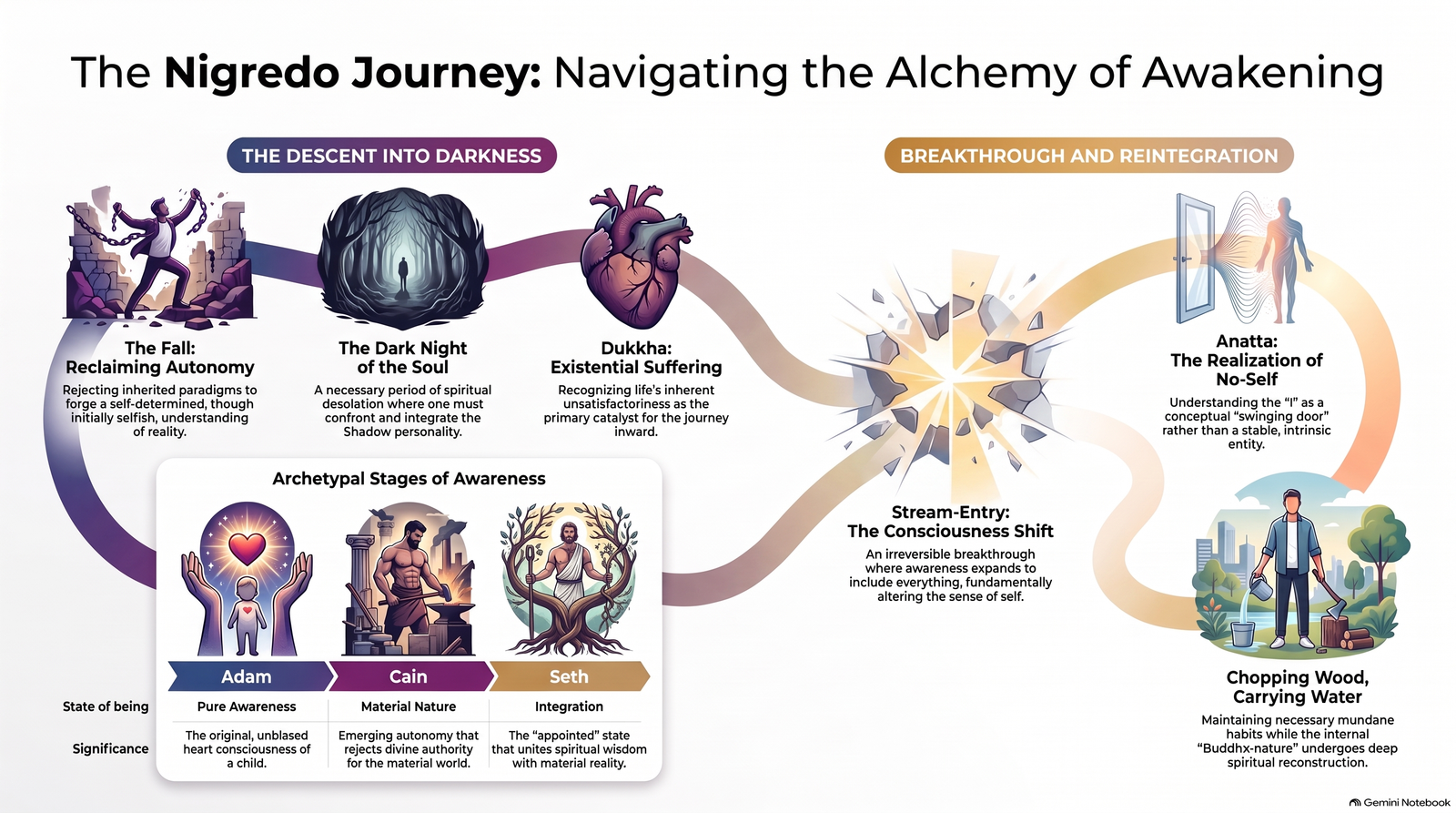
The Fall is then reread as movement from inherited innocence into autonomy. Adam, Cain and Seth become course-specific archetypes of pure awareness, material self-assertion and eventual integration. This is modern symbolic interpretation rather than biblical exegesis. The same applies to the discussion of Qabalah and alchemy: different traditions are being placed in conversation, not reduced to one historical teaching.
Exile becomes the condition of a self divided from what it cannot admit. Wandering and dukkha describe the failure of outward success to resolve that division. When distraction no longer works, the Night begins. The video’s language of demons, dismemberment and psychological death is symbolic; it must not turn depression, trauma, psychosis or loss of function into presumed spiritual progress.
The later movement follows breakthrough and aftermath. Stream-entry is described as a radical shift in the sense of ownership, but the immediate result is not a perfected personality. The recording stresses confusion, reconstruction, ordinary chores, restraint around grand spiritual identity and a gradual ethical warmth. Its final image—chopping wood and carrying water—makes integration more important than display.
Argument map
The movement of the overview
Six transitions carry the recording from inherited identity through disruption to a quieter form of participation in ordinary life.
A life becomes a story
Memory, medicine and professional competence create a coherent identity that appears capable of mastering experience.
Inherited authority falls
The Garden story is reinterpreted as the painful birth of autonomy, responsibility and divided self-consciousness.
Exile becomes wandering
Cain, Abel and Seth symbolise conflict between survival, conscience and the possibility of integration.
Success turns to ash
Dukkha names the inability of achievement, pleasure or identity to provide lasting settlement.
The Night breaks the structure
Rejected experience returns, familiar explanations fail and the constructed centre can no longer organise the whole.
Insight enters ordinary life
Breakthrough is followed by confusion, ethical reconstruction, humility and the unglamorous disciplines of daily integration.
Visual synthesis
Descent, breakthrough and reintegration
The infographic compresses the overview’s narrative into a single journey. It is most useful as an orientation device rather than a fixed sequence every person must follow.
Twelve chapter guides
Follow the Subject sequence
The first six chapters enter disruption and disorientation; the final six examine commitment, orientation and the work of integration.
1.4.1. What Went Before
Places curiosity, medicine, depression and professional uncertainty within a retrospective account of how a search began.
Open chapter guide → Chapter 38 of 481.4.2. The Fall
Reads the Fall as a departure from inherited authority into autonomy, responsibility and the difficult work of integration.
Open chapter guide → Chapter 39 of 481.4.3. Exile
Uses Cain, Abel and Seth to explore division between survival, conscience and a more integrated relation to material life.
Open chapter guide → Chapter 40 of 481.4.4. Wandering
Asks why conventional success can remain unsatisfying and how the recognition of dukkha deepens the search.
Open chapter guide → Chapter 41 of 481.4.5. The Night
Enters the confrontation with rejected experience, inner division and the material the constructed self cannot assimilate.
Open chapter guide → Chapter 42 of 481.4.6. Confusion
Examines the disorientation that can follow when an established map of self and world has loosened but a new orientation is not yet stable.
Open chapter guide → Chapter 43 of 481.4.7. Commitment
Turns from searching among explanations towards a sustained discipline capable of carrying insight into conduct.
Open chapter guide → Chapter 44 of 481.4.8. Spiritual Orientation
Considers how life is reoriented after breakthrough without mistaking intensity, certainty or unusual experience for completion.
Open chapter guide → Chapter 45 of 481.4.9. No-Self
Approaches anattā as the loosening of ownership and defence rather than the destruction of personality or ordinary function.
Open chapter guide → Chapter 46 of 481.4.10. First Steps
Returns to the unchanged world after insight and asks what begins when familiar actions are no longer organised in the same way.
Open chapter guide → Chapter 47 of 481.4.11. Establishing the Way
Explores repetition, restraint and patient practice as a new orientation becomes embodied in ordinary choices.
Open chapter guide → Chapter 48 of 481.4.12. The Key to the Gate
Closes Nigredo with ethical warmth, no-self and the recognition that the gate is entered through lived integration rather than possession.
Open chapter guide →Clickable video chapters
Navigate the overview
These markers follow the supplied final transcript and all remain within the stated duration of 45:53.
- 00:00Awakening Without the Sanitised Story
- 03:03Nigredo and the Architecture of Identity
- 05:27Memory and the Story of a Self
- 08:43The Fall as the Birth of Autonomy
- 15:58Cain, Abel, Seth and the Divided Mind
- 20:39Why the Perfect Life Feels Empty
- 23:10The Dark Night and the Return of the Shadow
- 29:19Stream-Entry and the Collapse of Ownership
- 32:12After Enlightenment: Carry Water
- 39:43Rejecting the Spiritual Ego
- 42:25The Key to the Gate
Terms for orientation
A compact Subject glossary
These definitions distinguish the course’s symbolic vocabulary from historical, doctrinal and clinical meanings.
Subject
The lived and apparently personal side of the course’s map. Here the question is not only what consciousness or awakening means, but how disruption, interpretation and practice are experienced by a person over time.
The Fall
The course reads the Genesis story symbolically as a transition from inherited innocence into autonomy and divided self-consciousness. This is a modern interpretive use, not a claim about the sole or original meaning of the biblical text.
Adam, Cain and Seth
Figures from Genesis used in the recording as archetypal stages: undivided awareness, material self-assertion and a possible integration of spiritual understanding with embodied life. This tripartite developmental map belongs to the course.
Dukkha
Pain, distress and the deeper unsatisfactoriness of unstable experience. The recording uses the traditional threefold distinction between ordinary suffering, suffering through change and the unsatisfactoriness of conditioned existence.
Dark Night
A Christian mystical expression later used more broadly for spiritual desolation. In this course it also carries alchemical and psychological meanings. It should not be used to romanticise or self-diagnose depression, trauma, psychosis or other conditions requiring care.
Stream-entry
Sotāpanna, the first of four stages in Theravāda Buddhism, traditionally associated with ending the first three fetters. The overview gives it a strong autobiographical and phenomenological interpretation; private intensity alone cannot certify the attainment.
Anattā / no-self
The Buddhist teaching that no permanent, independent essence can be found as the owner of changing experience. It does not mean that conventional persons, responsibilities, memories or personalities cease to function.
Spiritual ego
A modern term for identity organised around being advanced, chosen or unusually insightful. The recording treats secrecy, ordinariness and continued practical responsibility as safeguards against converting insight into another defended status.
Chop wood, carry water
A widely circulated modern Zen-style saying whose exact provenance is uncertain. Here it names the return to necessary tasks before and after insight: the world remains ordinary even when the relation to ownership and identity changes.
Brahmavihāras
Loving-kindness, compassion, appreciative joy and equanimity: four “divine abodes” cultivated in Buddhism. The overview presents their increasingly natural expression as a sign of ethical integration rather than a badge of status.
Within the course
Related pathways
- Nigredo Part OneThe main landing page for the complete first volume and all four sections.
- Object — Part Three of NigredoThe preceding section supplies the path and attainment maps that Subject returns to lived experience.
- Begin with What Went BeforeEnter the twelve-chapter sequence through the autobiographical conditions from which the later interpretation emerges.
- Close with The Key to the GateComplete Nigredo with ethical integration, no-self and the return to ordinary life.
Beyond the course
External reference points
- Genesis 2:15–4:26 — NRSVUEThe biblical narratives of the Garden, the Fall, Cain and Abel, and the birth of Seth used by the course’s symbolic interpretation.
- SN 56.11 — Setting the Dhamma Wheel in MotionAn early discourse on dukkha, its origin and cessation, and the path between extremes.
- SN 55.1 — A Wheel-Turning MonarchA primary Buddhist source contrasting worldly sovereignty with the traditional assurances of stream-entry.
- NHS — Clinical depressionCurrent practical guidance on symptoms, support and treatment, important when spiritual language overlaps with disabling distress.
A question to carry forward
What remains when your explanation of the journey is set down?
Choose one ordinary task you will perform today. Notice the memories, roles and self-descriptions that gather around it, then allow the task to be simple: the body moving, attention responding and consequences unfolding.
The aim is not to deny your history or manufacture a state of no-self. It is to discover whether experience needs quite as much narration and ownership as the mind habitually supplies.