
Mythos: When Enlightenment Becomes Another Attachment
What happens when even the pursuit of awakening becomes something the mind tries to possess?
Watch the Mythos overview
Why Even Enlightenment Can Become a Trap | Citrinitas: Mythos
Open the overview on YouTube · 35 minutes 54 seconds
The two-host NotebookLM discussion is an AI-generated interpretation of the book, not an authorised translation, a clinical presentation or a final statement of Buddhist doctrine.
Mythos in brief
The twelve opening chapters of Citrinitas, Revised Edition (2026), introduce the author’s solar or yellowing phase through the philosopher’s egg, Theravāda attainment language, concentration and insight, tantric symbolism, visionary Dzogchen teachings, the Heart and Diamond Sūtras, transitional states, the bodhisattva ideal and the three bodies of Buddhahood. The sequence places the pursuit of clarity under suspicion: a mind that releases ordinary desire may still cling to refined states, special knowledge or spiritual identity.
These chapters deliberately bring differing historical traditions into conversation through alchemical metaphor. They do not claim to constitute a single authoritative Buddhist curriculum. The overview draws selectively from them; it does not discuss each chapter in equal detail and is intended as a companion to the text, not a substitute for the individual lessons.
The central question: who owns awakening?
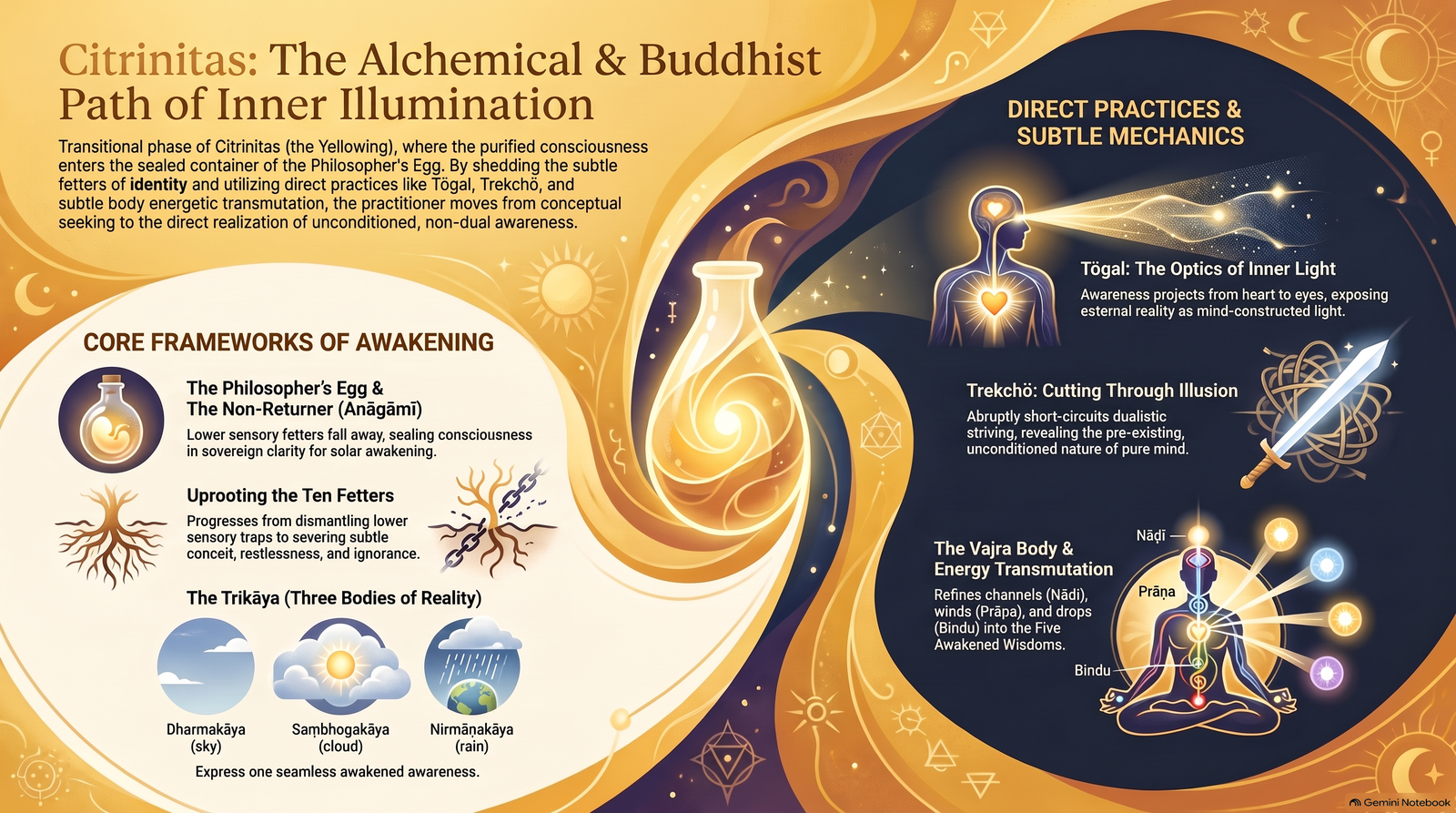
The discussion opens with a dramatic claim that human perception works like a projector rather than a window. It then works backwards to the alchemical philosopher’s egg, described as a sealed space of stability. Its Buddhist counterpart is the anāgāmī, or non-returner: in Theravāda formulations, a practitioner understood to have abandoned the five lower fetters. The hosts use the phrase “golden chains” to name a subtler problem: freedom from obvious craving is not freedom from attachment to bliss, status or the idea of being spiritually exceptional.
From there the recording considers samatha and jhāna, the five hindrances and the alchemical term fixatio. Its argument is that detachment need not entail withdrawal from everyday responsibility. The metaphors become increasingly mechanical: attention as a pressurised vessel, mantra as a sonic anchor, and tantric winds, channels and drops as the imagined “wiring” of consciousness. Those comparisons belong to the recording’s interpretive vocabulary. The subtle-body system is a traditional contemplative model, not verified anatomy; the claim that perceptions are literally projected outwards by the eyes is not supported by established visual science.
The middle of the dialogue turns to Tögal and visionary luminosity, treating visions as if they exposed the pixels of a simulation. That is a striking analogy, not an empirical discovery about photons or visual processing. The Diamond Sūtra, compared here to alchemy’s dissolving green lion, provides the philosophical counterpoint: even insight into emptiness can become an object of possession. The story of Asaṅga and Maitreya and the later discussion of Trekchö redirect the argument from achievement towards non-grasping and compassionate concern. The story is a traditional devotional narrative, not a verified historical event or an invitation to injure oneself.
Finally the video introduces the trikāya, using sky, cloud and rain to picture the relationship between ultimate truth, luminous expression and compassionate appearance. In the recording, this completes the movement from isolation to service. Its strongest conclusion is ethical rather than optical: whatever a person believes about awakening, the relevant test of their understanding is not a claim to a special inner status but how they meet other people. The three-body teaching is specific to Mahāyāna and Vajrayāna traditions; it should not be folded into Theravāda attainment categories as though all were one map.
How the argument unfolds
The projector provocation
The hosts begin by questioning ordinary perception but overstate a metaphor as a physical mechanism.
The egg and the golden chains
The non-returner and the fetters lead to the subtler danger of identification with refined states.
Stability in ordinary life
Jhāna, the hindrances and fixatio frame detachment as compatible with responsibilities and care.
The subtle body and the temptation of power
Mantra and tantric terminology introduce an energetic model and the risk of spiritual inflation.
Visions and the solvent
Tögal imagery raises a further attachment, which the Diamond Sūtra and green lion are used to challenge.
Effort gives way to compassion
Asaṅga’s story and Trekchö move attention from acquisition towards non-grasping.
Sky, cloud and rain
The trikāya becomes the final image of wisdom expressed through compassionate action.
Jump to a video chapter
These are the supplied, estimated chapter starts, not times independently verified against the final video frame by frame.
- 00:00The Paradox of Spiritual Awakening
- 02:20The Philosopher’s Egg and the Non-Returner
- 05:15The Golden Chains of Attachment
- 07:05Jhāna and the Five Hindrances
- 08:30Fixatio: Detachment Without Withdrawal
- 12:20Yoga, Mantras and the Vajra Body
- 16:10Spiritual Powers and the Danger of Ego
- 20:00Tögal: Visionary Experience and Perception
- 23:55The Diamond Sutra and the Green Lion
- 27:05Asaṅga, Maitreya and Compassion
- 28:55Trekchö: The Paradox of Effort
- 31:00The Three Bodies of Buddhahood
- 33:50Returning to the World Through Compassion
The twelve Mythos chapters
These are the Revised Edition (2026) book identities, in the author’s 3.1.1–3.1.12 catalogue notation. Links retain the published website destinations, as verified in the 15 October export; both the Bodhisattva and Three Bodies pages now follow the revised edition numbering.
The Philosopher’s Egg
The non-returner, the five lower fetters and the alchemical vessel of relative stability.
Tögal and Rainbows
The Dzogchen four visions and the distinction between luminous appearances and verified optics.
Mantras, Tantras and Deities
Yoking attention through sound and symbol; tantra and the traditional vajra-body model.
The Path of Tranquility
Samatha, the five hindrances and the role of absorption in classical Buddhist meditation.
The Path of Insight
Vipassanā, changing experience and the investigation of grasping and identification.
Sudden Methods
A critical look at sudden insight, including why shock and trauma are not recommended methods.
The Heart Sutra
The Mahāyāna teaching of emptiness, including its rejection of nihilistic conclusions.
The Bardo
Tibetan accounts of transitional states, death and rebirth, without claiming empirical proof.
The Bodhisattva
The bodhisattva ideal: compassion and wisdom without spiritual self-importance.
The Three Bodies
Trikāya: the dharmakāya, sambhogakāya and nirmāṇakāya in Mahāyāna thought.
The Diamond Solvent
The Diamond Sūtra as a challenge to clinging, even to views of wisdom and merit.
Trekchö
Cutting through fixation in Dzogchen, discussed here as a teaching rather than an exercise.
Illustrated map: the path of inner illumination
Glossary: terms used in the overview
Citrinitas
In this course, the yellowing or solar phase of alchemical transformation. Its placement between Albedo and Rubedo is the author’s course architecture, not a Buddhist attainment stage.
Philosopher’s Egg
An alchemical emblem of containment and transformation. Here it represents steadiness without compulsive involvement. It does not require literal social isolation or emotional numbness.
Anāgāmī
Pāli for “non-returner”, a Theravāda stage associated with abandonment of the five lower fetters. This is a traditional attainment category and not a diagnosis inferred from outward behaviour.
Saṃyojana (fetters)
Ten forms of attachment or confusion listed in early Buddhist sources. Five lower and five higher fetters appear in AN 10.13; the higher include attachment to form and formless existence, conceit, restlessness and ignorance.
Samatha and jhāna
Samatha means calming or tranquillity cultivation; jhāna refers to meditative absorption in Pāli Buddhist literature. They are not simply pressurisation of psychic energy.
Fixatio
A Latin alchemical word for making something fixed or stable. The recording interprets it as emotional steadiness in ordinary activity, not an independently defined Buddhist achievement.
Vajra body
A term for contemplative subtle physiology in some tantric systems involving winds, channels and drops. It is not a verified second nervous system and does not license claims about literal biological transmutation.
Tögal
An advanced visionary approach within Dzogchen, often discussed alongside the four visions. Reports of luminous forms are interpreted within particular lineages; the overview is explanatory, not a safe practice manual.
Diamond Sūtra
A Mahāyāna Perfection of Wisdom text concerning non-grasping and emptiness. The green lion is an alchemical comparison introduced by the author and hosts, not a historical Buddhist synonym for the sūtra.
Trekchö
A Dzogchen term commonly rendered “cutting through”. The recording uses it to criticise grasping at accomplishment; recognition of rigpa is a lineage-specific topic, not merely relaxation.
Asaṅga and Maitreya
Figures in Mahāyāna literary and devotional traditions. The wounded-dog episode is a teaching story about compassion; it is not a substantiated biography or permission for self-harm.
Trikāya
The three bodies of a Buddha in Mahāyāna thought: dharmakāya, sambhogakāya and nirmāṇakāya. Sky, cloud and rain are teaching analogies, not three literal meteorological or anatomical stages.
Emptiness (śūnyatā)
Especially in Madhyamaka, the lack of independent, intrinsic nature. It does not assert that suffering, beings or moral consequences are non-existent in ordinary experience.
Reference points
- AN 10.13, Saṃyojana Sutta — Thanissaro Bhikkhu’s translation of an early Buddhist list of the ten fetters.
- Stanford Encyclopedia of Philosophy: Madhyamaka — Academic context for emptiness and the rejection of intrinsic nature.
These references provide background and corrections; they are not additional material claimed to be quoted in the recording.
A question to carry forward
When does a good idea become an identity?
The video warns against claiming enlightenment as a possession. Where, in ordinary conversation or relationships, might the wish to be seen as wise make it harder to listen, revise a belief or respond kindly?